
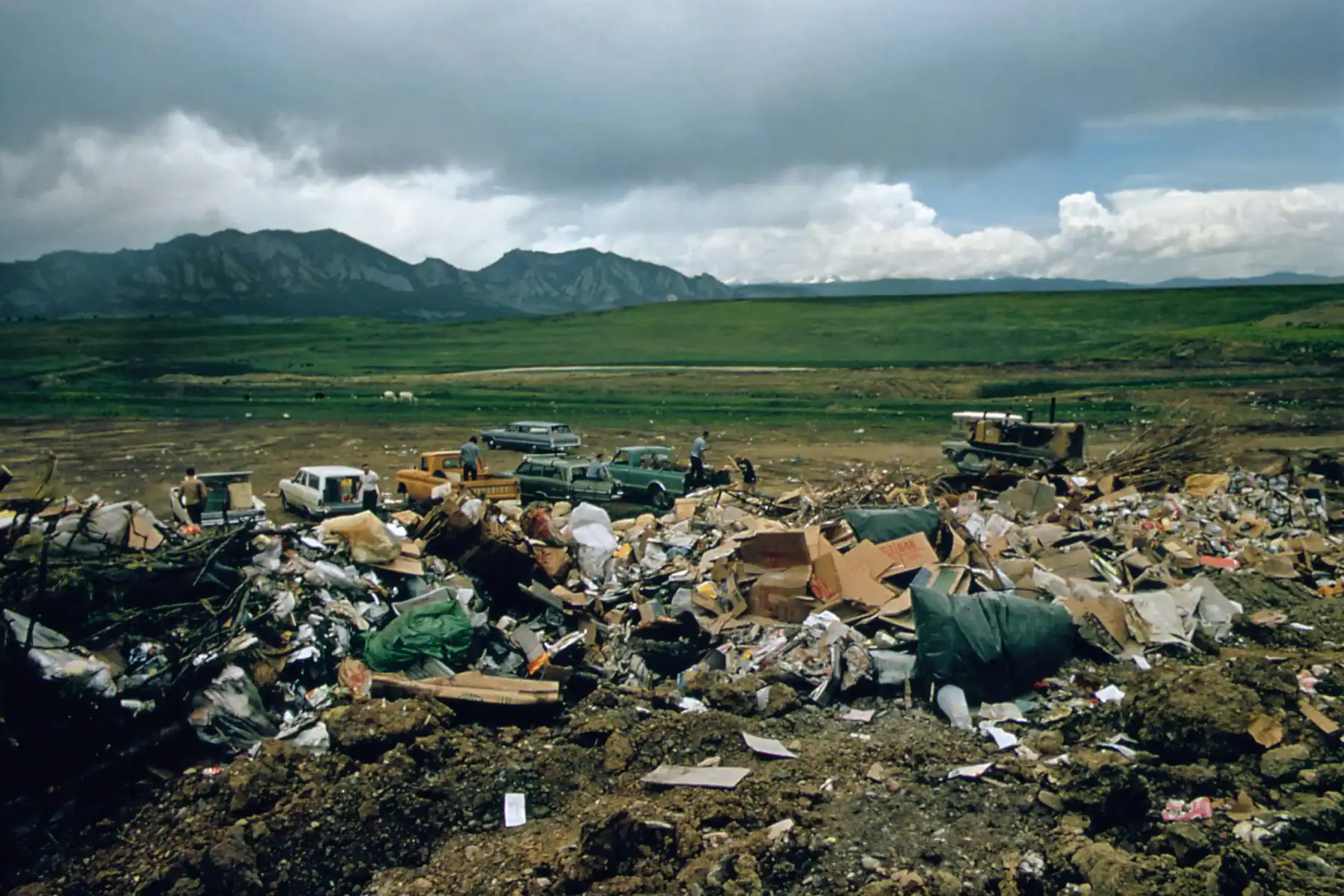
Have you ever wondered what happens when you throw out the rubbish? Humanity now produces billions of tonnes of waste and greenhouse gas (GHG) emissions every year. This overconsumption means we’re using natural resources at an unsustainable rate – faster than the Earth can replenish them. Here’s why consuming less matters.
Overconsumption is increasing
Municipal waste refers to standard “town” waste produced by individuals in households and small businesses (i.e. what you and I might throw in the bins once a week). According to research by Statista, annual municipal waste per capita is 811.5kg per year in the United States (one of the highest in the world), and 436.3 kg in the UK.
I often compare the UK and the US in terms of living standards and environmental impact, but it’s clear that Americans consume more than the British – resulting in nearly twice as much waste per person. That’s an awful lot. Still, even within the UK, more can be done to reduce the amount of waste produced – including improving recycling facilities, increasing access to high-quality recycling for more people, and an improved emphasis on reducing consumption.
Given that rich countries consume the majority of the world’s resources, there should be a focus from all people in wealthy countries to consume less. And there’s only so much governments can do to control this. The actions of governments are ultimately controlled by the will of the people – if there is a change in public sentiment over something, and their will is strong enough, government sentiment will change too. So, pressure for reducing consumption on a country level can only come through the people.
There’s more that can be done on an individual level too – you just need to make more of an effort. More effort to recycle properly rather than just throwing things in the rubbish – which is often the easier option. More effort to intentionally reduce your consumption – by buying less, buying used, reusing stuff you already have and transitioning away from fossil fuels.
Overconsumption is the root of all our problems
Think about it. Deforestation, clearing land for farming, urbanisation, overfishing of the oceans, depletion of the ozone layer, habitat destruction, biodiversity decline, global warming, are all attributed to the growing global population and our insatiable desire to have more. The ONLY way we can get to the root cause of these problems is if we, as individuals, consume less stuff. This means buying less, eating less meat and being more conscious of where everything we consume comes from.
The world would be a much better place if everyone learned to consume less and realised that true happiness and contentment in life does not come from material items and money. That’s the whole point of this website – I’ve talked about how slowing down your life can actually lead to greater contentment before.
The profound benefits of consuming less
Think about how much less suffering there would be if people consumed less – there’d be less fighting over land and resources for a start, making the rest of us feel safer and happier. There’d be less pressure on biodiversity, with more unspoiled landscapes for creatures to live in.
We’d be able to tackle global warming much more easily, and the healthier planet would more easily be able to sustain the remaining population – less climate-change fuelled extreme weather events wreaking havoc around the world and a healthy ecosystem that humanity could prosper from.
Of course this all sounds very far-fetched, but the simple (yet profound) act of reducing consumption, especially in the rich countries, would have a major positive benefit on the Earth’s natural resources.
Reduce, reuse, recycle
You’ve probably heard of the above phrase, but do you know what it actually means? The order of the words is how you should think when consuming. First, can you reduce the consumption of said resource? If not, can you reuse it in some other way? (Like reusing old jam jars as pen holders, or even to make your own delicious jam!) If not, then you should recycle where possible, rather than just throwing away.
If the average US citizen generates 811.5kg of waste per year, and the average Brit generates 436.3kg, the global average municipal waste production is roughly 270kg per person per year. So, there’s a lot of waste produced around the world. People in all countries need to be reducing their consumption and the amount of waste they produce. But the rich countries need to do it the most.
Recycling more is of course a good starting point, but reducing and reusing are better. Let’s consider countries with the highest recycling rates:

What’s the deal with America?
I’ve lived in the US for close to a year, and I understand that waste reduction and recycling are not always a priority in many parts of the country. But the reason for this is a combination of top-of-the-chain (big retailers and government) and bottom-of-the-chain (individual consumer) demands.
There is clearly not enough pressure from the individual consumer in the US for less packaging and better recycling facilities. So, the retailers continue to provide excessive packaging and local authorities neglect recycling practices.
To be fair, recycling rates in the UK are not much better than in the US, but another (more sensitive) point, is that the average American simply consumes more than the average Briton. Houses are larger, roads are wider, and cars tend to be bigger. Everything is built far apart with space rarely a concern.
Fundamentally, it is just not such an efficient use of resources as in other developed countries (Europe, Japan and even China come to mind). I believe that, for change to occur, pressure needs to be applied from the bottom up – i.e. from the individual upward towards industry and ultimately to the government.
50% of all municipal waste in the US goes to landfill, one of the highest rates in developed countries. Both the UK and the US are near the bottom of the list (for recycling rates), and it’s interesting to note that the UK incinerates a lot of its waste.
Every country should aspire to be more like South Korea, which reportedly recycles more than half of its municipal waste. Having been to the country several times, I know that Germany has a particularly well-developed recycling industry as well.
Recycle more – but first, consume less stuff
We’ve learnt that recycling rates need to be higher – but in the first place, we need to reduce our overconsumption – and this starts from the consumer level. We all have a commitment to reducing the amount of waste we produce, both directly and indirectly, and it is here that we find ourselves at the intersection between saving the planet and personal finance. There is a lot of overlap between the two – and indeed one which this website promotes strongly.
Bringing it all back together, we find that the US has a much greater contribution to per-capita GHG emissions than most other countries – a combination of very high per-capita consumption and an energy mix with fewer renewables and nuclear relative to other developed countries:

Global GHG emissions are still too high
On the bright side, at least historically large emitters (the UK, EU, US) have reduced emissions over the past ~25 years. The downward trajectory is good, but is clearly not happening fast enough worldwide, as annual global CO2 emissions continue to rise. We need more to happen – and fast – if we want to avoid even worse impacts from climate change.
The major concern now is how developing countries, like China and India, with a combined population of around 3 billion, will manage their emissions. China has by far the world’s largest installed capacity of wind and solar power, but is also (by far) the largest emitter of GHG emissions.
With a growing global population demanding a better quality of life, the only way to reduce emissions and consumption is if the individual – you and I – make changes to the way we live. This doesn’t necessarily mean a ‘worse’ lifestyle – just one which is different (and which puts the planet and your money at the forefront).
On this website, I advocate living an intentional lifestyle, with saving money and reducing environmental impact at the forefront. Consuming less is one of the simplest ways to achieve both goals. Buying less stuff means keeping hold of more money, allowing you to reach financial independence earlier and to live the life you want – not the one your job dictates. AND it’ll leave behind a better planet for our children.
Want to find out more? You might be interested in the following posts:
- 14 ways to live an easy life
- Why you should appreciate the simple things in life
- How to slow down your life by buying less
- A no-nonsense guide on how to live a healthy life
- How to not die early
You can follow me on X, and find me on Pinterest, Instagram and Facebook.
Leave a Reply