
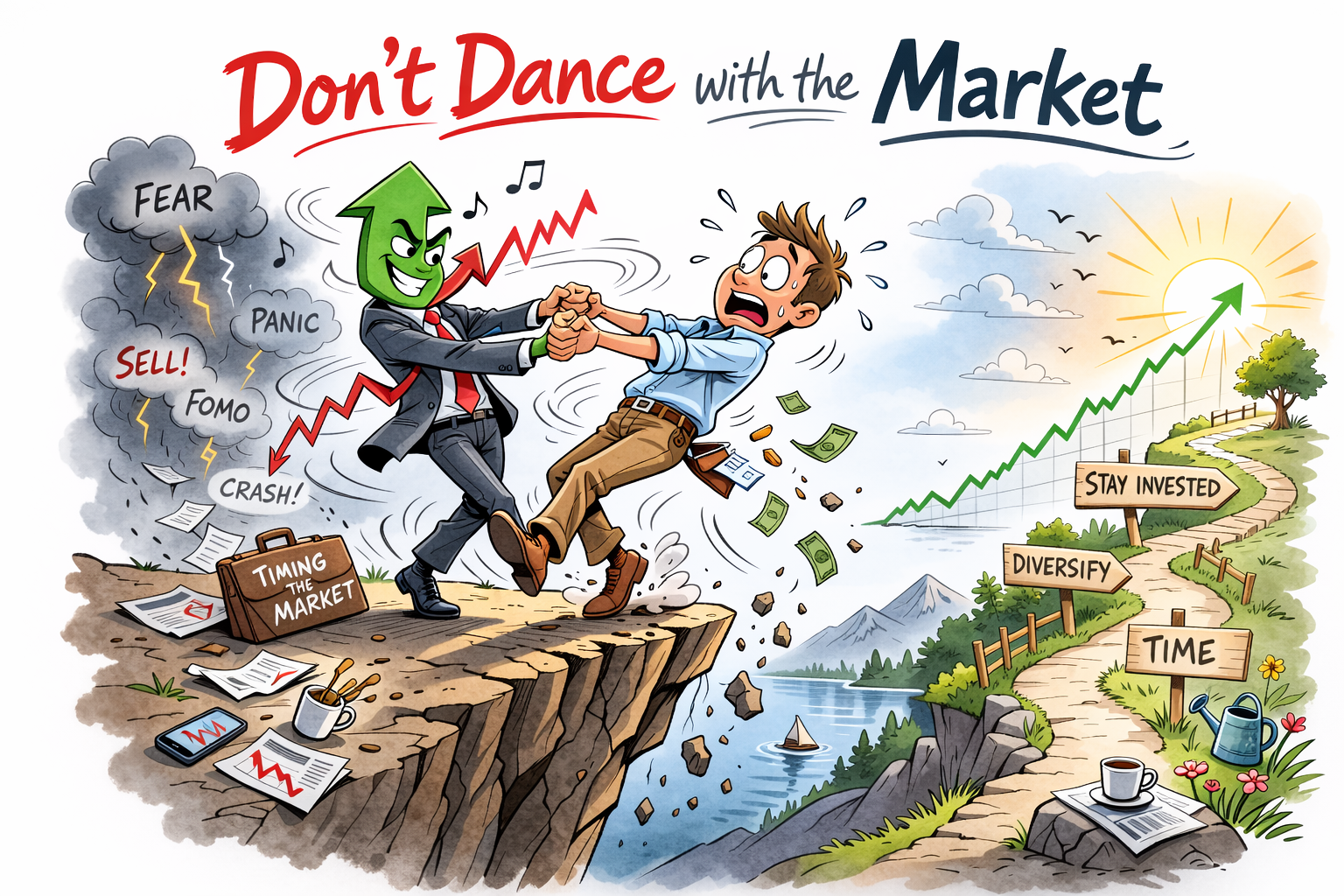
I’ve been listening to a lot of personal finance podcasts recently. ChooseFI really stands out as a brilliant opening resource into financial independence. On one particular podcast (I forget which one in particular), the hosts Brad and Jonathan were interviewing JL Collins (of The Simple Path to Wealth), when he went into a beautifully long-winded rant about how the stock market has risen wonderfully over the past ~100 years, and yet people have still managed to lose money. How can this be?
Well, you see the average time someone holds a stock has been reducing over recent decades. In the 1950s, it was 8 years, and it’s now down to around 5.5 months. People have less and less patience to let the market do its thing (rise). The advent of easy-to-access internet trading, often with 0% commission fees, has contributed to this. And this is exactly why having a clear, long-term investing strategy matters now more than ever.
A long-term mindset
Since December 1978, the MSCI World Index has given a total return of 10,603% (to Jan 2026). The long-term investor cannot possibly lose money in such an incredible period of market returns. But if you’re trading with an investment horizon of 5.5 months, the tables aren’t stacked as favourably towards you.

The index had a (quite incredible) positive return in 35 of the 47 years (74%) between 1979 and 2025. I still struggle to visualise how people could lose money during such a strong period of positive returns. It seems to me that the global stock market is a gift from God – the greatest money making machine the world has ever known – but only for those who don’t jump off the gravy train too quickly.
Tighten your seatbelts folks, it’s going to be a bumpy ride
The stock market is inherently volatile – always has been and always will. The problem is that in today’s society of excessive information, and easier-than-ever access to the stock market, people are more likely to try and dance with it. This is a terrible idea! Stop. Stop. Stop!!! Broaden your horizon and see that the current downturn in the market is temporary.
TEM-POR-RARY.
Remember that the only permanent loss is the one you lock in by selling.
The market will go back up again eventually, just as it always has done. It may not be tomorrow, next week, next month or even next year. But eventually it will go up – in 74% of years, it’s gone up. That’s a decent win rate that I’m willing to bet on.
Many of the stock market’s best-performing months occur just after a market downturn. For example, the top two best months in the MSCI index were April 2020 (+11.7%, just after the Covid crash of March 2020) and April 2009 (+11.5%, just after rock-bottom during the ’08-’09 financial crisis).
So, to benefit from the best monthly market returns in history, you need to experience some horrific market downturns. If you sell during a downturn, there’s a good chance you’ll miss a quick bounce-back just a few months later. This is why a long-term investing strategy is so important – it protects you from reacting emotionally to short-term market movements.
My advice? Tighten your seatbelts and take a chill pill. Sit back and let the market do the heavy lifting for you – over many years and decades.
5.5 months is not enough time
You’re not giving yourself enough time to benefit from the stock market with such a short investing horizon – and you’re much more likely to be impacted by a market downturn. Consider drawdown periods for the MSCI World Index:

If you were unlucky enough to invest a lump sum in the stock market in August 2000, it wouldn’t be until February 2014 that you finally made a gain. You’d have to wait 13 years and 6 months(!) This is a long time in anyone’s book. You’d be incredibly unlucky if this happened to you; it’s a black swan event. Even so, for the investor with a 30+ year horizon, this is not a problem – your investment would be worth ~4x what you started with as of early 2026.
The investor with a 5.5 month horizon is going to hit problems. They’d be much more likely to make a loss during this period of poor market performance – and the psychological scars from the experience might scare them off investing for even longer. Even during shorter periods of market drawdown, like those which occur every couple of years, the short-term investor is more likely to make a loss, or at least negatively impact their gain vs if they stayed invested.
Individual stocks are even more volatile
By their nature, picking individual stocks will lead to even more volatility. Unless you’re exceptionally gifted, or Warren Buffett, you won’t be able to beat the stock market. So don’t kid yourself into thinking you can do it. You may get lucky a few times, but keep doing it and you’ll wind up underperforming the market (or worse, losing money).
Stock-picking, when combined with a short investment horizon, is a framework for failure over the long-term. You’re far more likely to buy/ sell at the wrong time (remember that, in order to correctly time the market, you have to be right twice – once when you buy and once when you sell).
If you have the guts to hold blue-chip stocks for a long period of time (20+ years), good for you. I don’t. Microsoft may be worth 50x its current value in 20 years time, or it may have gone out of business.
This idea highlights a fundamental truth about the stock market. If you invest in a single company and it goes out of business, you’ve lost all your money. If you invest in the global stock market, there’s no point in worrying about what would happen if the index goes to zero. I mean, it could theoretically drop to zero, but personally I’d be more concerned about the welfare of my family and where my next meal was coming from, rather than what happened to my money.
Let’s get back to a 1950s investing mindset
If the average time to hold a stock in the 1950s was 8 years, I’m in. With the Vanguard FTSE All-World UCITS ETF (VWRP), I’ve found an investment vehicle that I’m happy to hold forever. I don’t plan to ever sell unless I actually need the money. And I’m consistently investing into the fund every month through a direct debit.
Find an investing philosophy which you are happy with and stick with it. Remember Vanguard’s four key principles for successful investing:
- Set clear goals. Clear goals help you stay focussed, particularly when markets are in turmoil.
- Stay balanced. Make sure you’re comfortable with your investment risk, and make sure your portfolio is diversified.
- Keep costs low. Fees eat into your gains.
- Maintain discipline. Markets regularly fall. It is part of what investing is about, and it is perfectly normal. In our experience, maintaining discipline, sticking to the plan and rebalancing your portfolio, works.
Learn to manage your emotions
Successful investing is more about managing your emotions than picking the right fund. It’s about sticking to a long-term investing strategy, even when it feels uncomfortable.
The further into my investing journey I go, the more I realise how perfectly true this is. If you can master your emotions and not sell when the market has a downturn, you’ll end up rich, while everyone around you is dipping in and out of the market at the wrong times.
As Jack Bogle, the founder of Vanguard, once said:
“Index fund investing may be boring, but do me a favour: never open one of your statements from the day you start work to the day you retire. When you do eventually look, you should have a doctor standing by in case you have a heart attack.”
The stock market isn’t something to outsmart – it’s something to participate in. The investors who win aren’t the ones who react the fastest, but the ones who stay the longest.
A simple long-term investing strategy – consistently investing, staying diversified, and refusing to panic – is enough. You don’t need to dance with the market. You just need to stay in the game long enough for it to play out in your favour.
FAQ
A long-term investing strategy involves holding investments for years or decades rather than trading frequently. It focuses on consistent contributions, diversification, and ignoring short-term market noise. By staying invested over time, you benefit from compounding returns and reduce the risk of making costly emotional decisions during market volatility.
Most people lose money not because the market performs poorly, but because they react emotionally. Buying during market highs and selling during downturns leads to losses. Without a clear long-term investing strategy, investors often try to time the market, which few people can accurately do. Getting those decisions wrong can significantly reduce overall returns.
Selling during a market crash often locks in losses and prevents you from benefiting from the recovery. Historically, some of the market’s best gains occurred shortly after major downturns. A disciplined long-term investing strategy helps you stay invested during volatility, giving your portfolio time to recover and grow.
Ideally, you should stay invested for decades. The longer your investment horizon, the more you benefit from compounding and the less impact short-term volatility has on your returns. Remember that, over the long-term (years and decades), the market always goes up.
For most people almost certainly. Index funds provide broad diversification, low fees and consistent exposure to the market. This makes them ideal for a long-term investing strategy – where simplicity and discipline matter more than trying to pick winning stocks. Over time, almost all actively-managed funds fail to outperform low-cost index funds.
I hope you found this article useful. Here are some others you may enjoy:
- A life of joy means to never stop working
- The Best Paycheque Routine to Save, Invest and Build Wealth
- The best index funds to own in 2026 (UK)
- Why you need to consume less
You can follow me on X, and find me on Pinterest, Instagram and Facebook.
Leave a Reply