
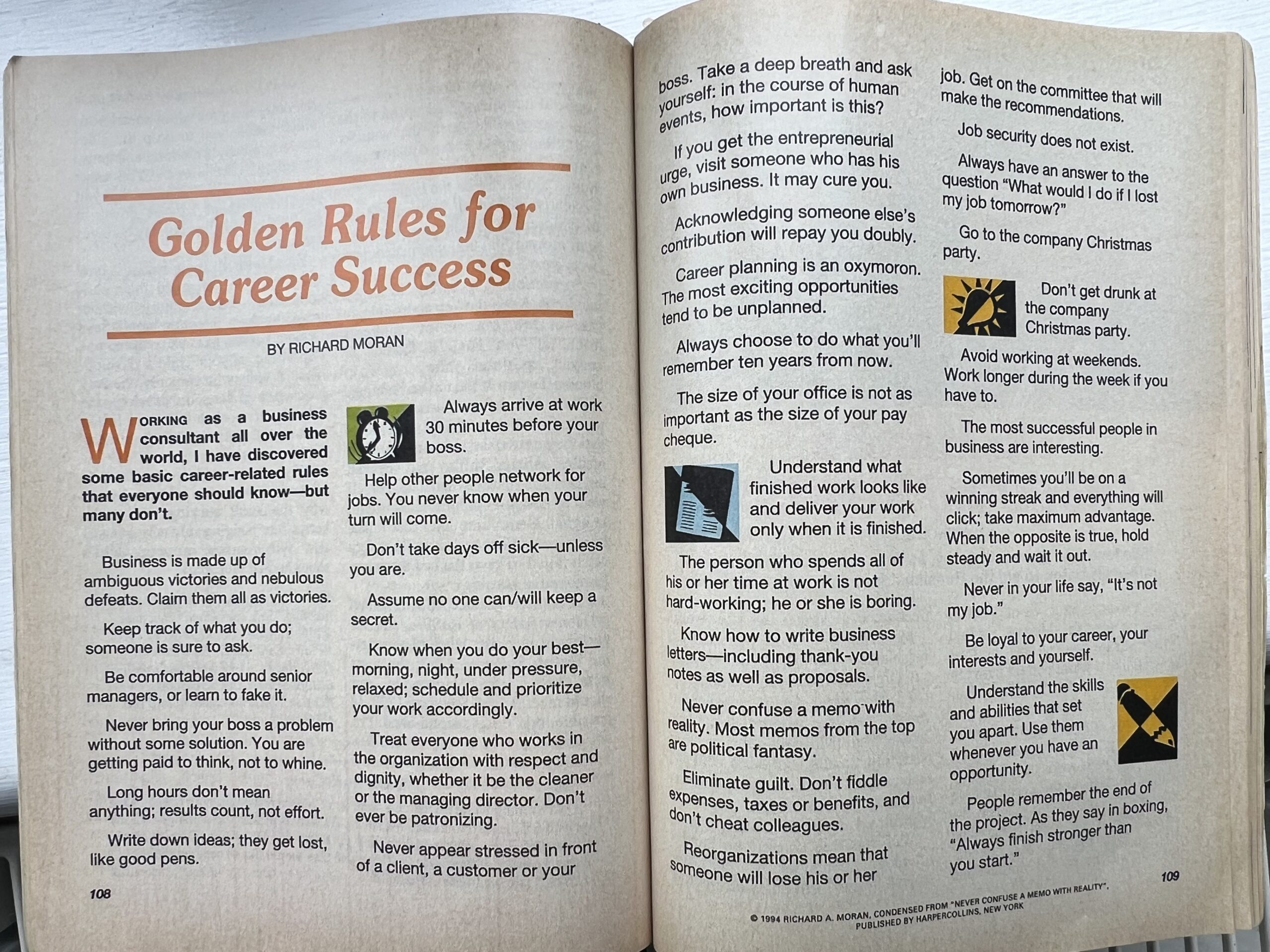
A couple of years ago, while clearing out my parent’s study, I stumbled across a gem from the May 1994 edition of Reader’s Digest: “Golden Rules for Career Success”. Even though it’s more than 30 years old, the advice is timeless and still resonates today.
The world of work can feel ambiguous, with wins and losses that aren’t always clear. These timeless rules cut through the noise, offering practical career success tips on how to get noticed, build a strong reputation, and create lasting momentum. They are a collection of actionable insights that anyone, whether just starting out or well into their career, can apply. From mastering office politics to making the most of opportunities, these golden rules are as relevant today as they were back in 1994.
The Golden Rules
- Business is made of ambiguous victories and nebulous defeats. Call them all victories.
- Keep track of what you do: someone is sure to ask.
- Be comfortable around senior managers, or learn to fake it.
- Never bring your boss a problem without some solution. You are getting paid to think, not to whine.
- Long hours don’t mean anything; results count, not effort.
- Write down ideas; they get lost, like good pens.
- Always arrive at work 30 minutes before your boss.
- Help other people network for jobs. You never know when your turn will come.
- Don’t take days off sick – unless you are.
- Assume no one can/ will keep a secret.
- Know when you do your best – morning, night, under pressure, relaxed; schedule and prioritise your work accordingly.
- Treat everyone who works in the organisation with respect and dignity, whether it be the cleaner or the managing director. Don’t ever be patronising.
- Never appear stressed in front of a client, a customer or your boss. Take a deep breath and ask yourself: in the course of human events, how important is this?
- If you get the entrepreneurial urge, visit someone who has their own business. It may cure you.
- Acknowledging someone else’s contribution will repay you doubly.
- Career planning is an oxymoron. The most exciting opportunities tend to be unplanned.
- Always choose to do what you’ll remember ten years from now.
- The size of your office is not as important as the size of your paycheque.
- Understand what finished work looks like and deliver your work only when it is finished.
- The person who spends all of his or her time at work is not hard-working; he or she is boring.
- Know how to write business letters – including thank-you notes as well as proposals.
- Never confuse a memo with reality. Most memos from the top are political fantasy.
- Eliminate guilt. Don’t fiddle expenses, taxes or benefits, and don’t cheat colleagues.
- Reorganisations mean that someone will lose his or her job. Get on the committee that will make the recommendations.
- Job security does not exist.
- Always have an answer to the question “What would I do if I lost my job tomorrow?”
- Go to the company Christmas party.
- Don’t get drunk at the company Christmas party.
- Avoid working at weekends. Work longer during the week if you have to.
- The most successful people in business are interesting.
- Sometimes you’ll be on a winning streak and everything will click; take maximum advantage. When the opposite is true, hold steady and wait it out.
- Never in your life say, “it’s not my job”.
- Be loyal to your career, your interests and yourself.
- Understand the skills and abilities that set you apart. Use them whenever you have an opportunity.
- People remember the end of the project. As they say in boxing, “Always finish stronger than you start”.
Have an unchanging set of principles
It’s important to remember that careers aren’t linear – and success rarely comes from following a strict set of instructions. These golden rules offer something even more valuable: a timeless mindset. They remind us to stay observant, be proactive, treat others with respect, and take ownership of our work — all while keeping perspective on what truly matters.
The world of work can be unpredictable. Projects end, companies reorganise, and opportunities appear when we least expect them. By internalising these principles, you’re not just preparing to survive the workplace — you’re positioning yourself to thrive, to be remembered for your contributions, and to make choices that align with your long-term goals.
So, whether you’re just starting out, navigating a tricky role, or considering your next big move, these rules are a compass. Apply them thoughtfully, stay adaptable, and you’ll find that career success is less about luck and more about consistently making smart, intentional choices.
I hope you found this post useful. Here are some others you may enjoy:
- A life of joy means to never stop working
- How to slow down your life by buying less
- The best routine for your pay check
- Cycle more to save money (and get fit)
You can follow me on X, and find me on Pinterest and Facebook.
Leave a Reply