
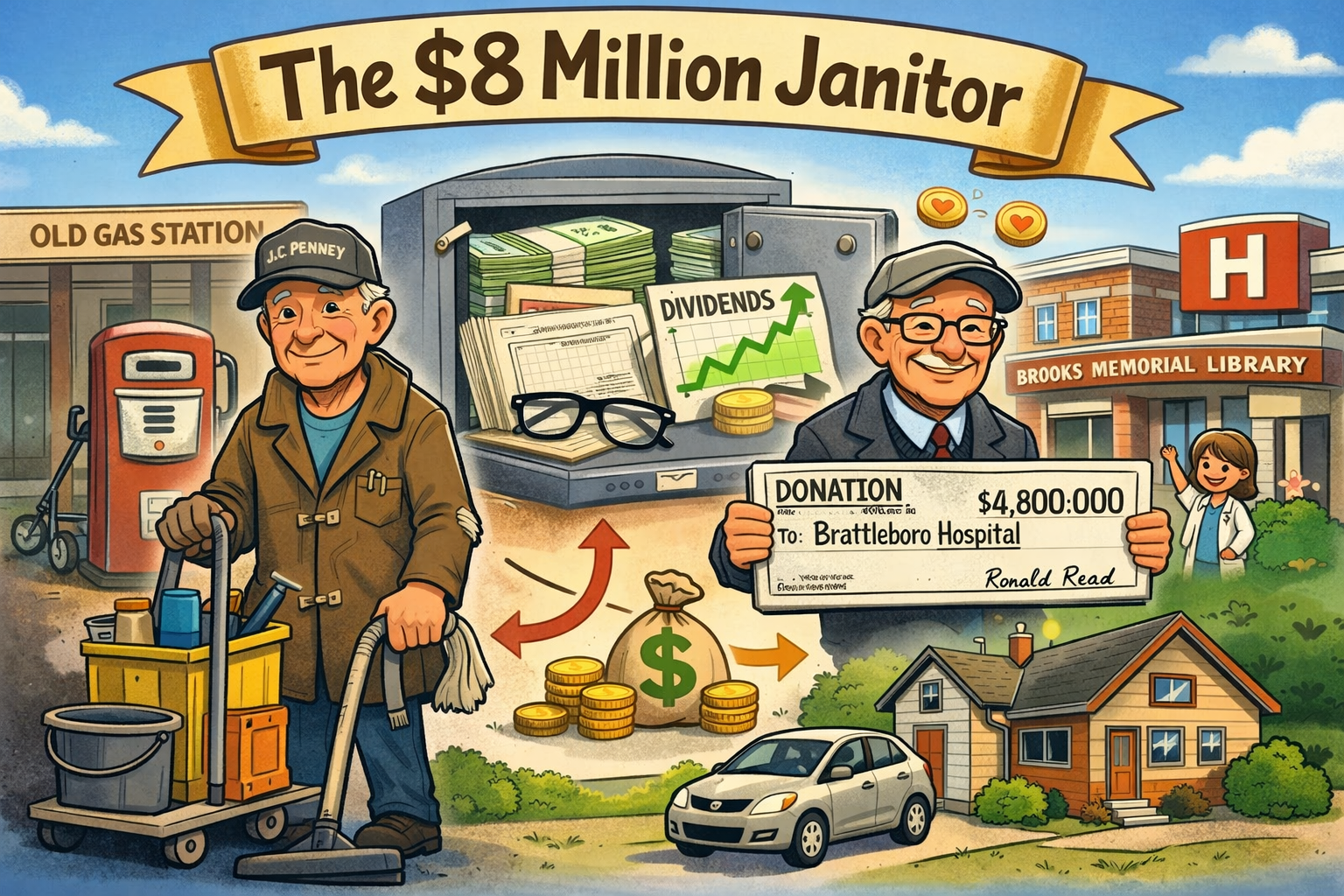
In 2014, a quiet man from rural Vermont died at the age of 92. His name was Ronald Read.
He had worked most of his life as a petrol station attendant, and later as a part-time janitor. He drove used cars throughout his life, and often wore the same clothes to save money. When they eventually wore out, he held them together with safety pins.
No one considered him wealthy, but when he died, he left behind nearly $8 million.
Stealth wealth
Ronald Read was born in 1921 in Vermont. He was the first in his family to finish high school, and after serving in the Second World War, he returned home and began working ordinary jobs. He never got lucky with tech startups or windfall inheritances.
He did, however, work hard for many decades, and he also did something extraordinary in its simplicity: he saved and invested consistently, throughout his entire life. Quietly.
For someone who worked such humble jobs, this is the pure definition of stealth wealth. No-one suspected. Not even his stepson was aware of how wealthy he really was.
The power of unremarkable consistency
Read didn’t chase trends or speculate wildly. He bought “blue chip” shares in established, dividend-paying companies, and held them for decades. (Blue chip stocks are shares of large, well-established, and financially sound companies with a reputation for quality, reliability, and operating profitability.)
He reinvested the dividends, lived well below his means and allowed time to do the heavy lifting. When his estate was examined after his death, most of his wealth was found in a simple stack of share certificates sitting in a safe-deposit box (the stack was allegedly five inches thick).
This story epitomises the power of extreme consistency and patience. In many ways, I find it even more impressive than Warren Buffet’s story and the huge fortune he has amassed. Buffet is rightly celebrated – but he also had exceptional skill, access and opportunity. Read simply had discipline and time. The patience he exercised is nothing short of extraordinary.
The quiet millionaire next door
Neighbours described him as frugal to the point of eccentricity. He lived well below his means, collecting firewood and rarely buying new clothes. And yet, behind the scenes, compounding was relentlessly working in his favour.
What’s most impressive to me is that he did not leave his fortune to distant heirs, but rather donated the majority of it. He left $4.8 million to the hospital where he went daily during his retirement to have a muffin and a coffee (and also the hospital which looked after him towards the end of his life). He left $1.2 million to the local library, with the remainder going to stepchildren and caretakers.
Both the hospital and library were stunned. These were the largest single donations they had ever received.
What can we learn?
It’s easy to believe that wealth requires a consistently high income and luck with your investments. Ronald Read proved this is not the case. He had modest salaries his entire life. Based on his lifestyle, onlookers may have even thought he was poor. However, he had discipline and time on his side, and he let compounding work its magic.
Most people dramatically underestimate what 30, 40 or 50 years of patient investing can do. Read simply refused to interrupt the process. His story reminds us that wealth does not have to be a statement, nor does it have to be rushed. It can be slow and deliberate, built up over many decades – almost invisible.
A cautionary tale
Not everything Read did fits the lifestyle of conscious investing and intentional living. Yes, he accumulated enormous wealth through his investing. He absolutely nailed that. Fair play. But money is a tool to be used to enjoy life with – and he missed the point here. Because Read remained frugal his entire life, he never spent much (or any?) of his investments. He never used his wealth to improve his own life, or, for that matter, to help others around him while he was still alive. Instead, he continued to live frugally.
You have to ask the question: what’s the point of saving and investing diligently if you don’t get to enjoy it? Maybe he genuinely enjoyed frugal living, and instead wanted to leave behind an estate that he would be remembered by. We cannot know.
As early_retire puts it on Reddit: “He’s more of a cautionary tale than an example to me. He made millions and enjoyed none of it. He died with millions but held his clothes together with safety pins. Money is a tool to reach a goal, but it shouldn’t be the goal itself.“
Investing is supposed to be boring
While his story was picked up by the media after his death (upon the stunning discovery of the estate he left behind), his story of quiet investing success won’t blow up on social media. It’s just not interesting. Nobody wants to wait for 50 years to make their fortune, while living a life of frugality in the meantime.
Too many people these days are looking for the next tech start-up that’s about to explode in popularity. Illustrated by a number of pre-IPO investment brokers that now exist to let you (probably waste) money on start-up companies that may be the next big thing. Doing well here is akin to winning the lottery. It requires a lot of luck. These services didn’t exist back in Read’s time.
Read invested in what he knew – well managed companies with a history of strong performance and increasing dividends. He steered clear of things he did not understand – including tech stocks. His story quietly dismantles the myth that investing success belongs only to the high-earning or financially sophisticated.
Sometimes, the most powerful strategy is simply to stay the course.
I hope you found this article interesting. Here are some others you may also enjoy:
- 2025 review – the year of Life
- How to get a good nights’ sleep
- Why you need to become an Athlete of Life
- Make consistent investing the #1 priority with your money
You can follow me on X, and find me on Pinterest, Instagram and Facebook.
Leave a Reply