
There is a particular kind of wealth story that tends to dominate public attention. It involves founders, hedge fund managers, or investors who appear to have predicted the future perfectly. These stories are dramatic and fast-moving, but difficult to relate to and far beyond the reach of most people.
But there is another category of wealth creation that is far less visible – and far more relevant to most people. It is slow, repetitive, and it rarely looks impressive while it is happening – it’s the story of the simple path to wealth.
The story of Sylvia Bloom is a clear example of this quieter path.
An ordinary working life
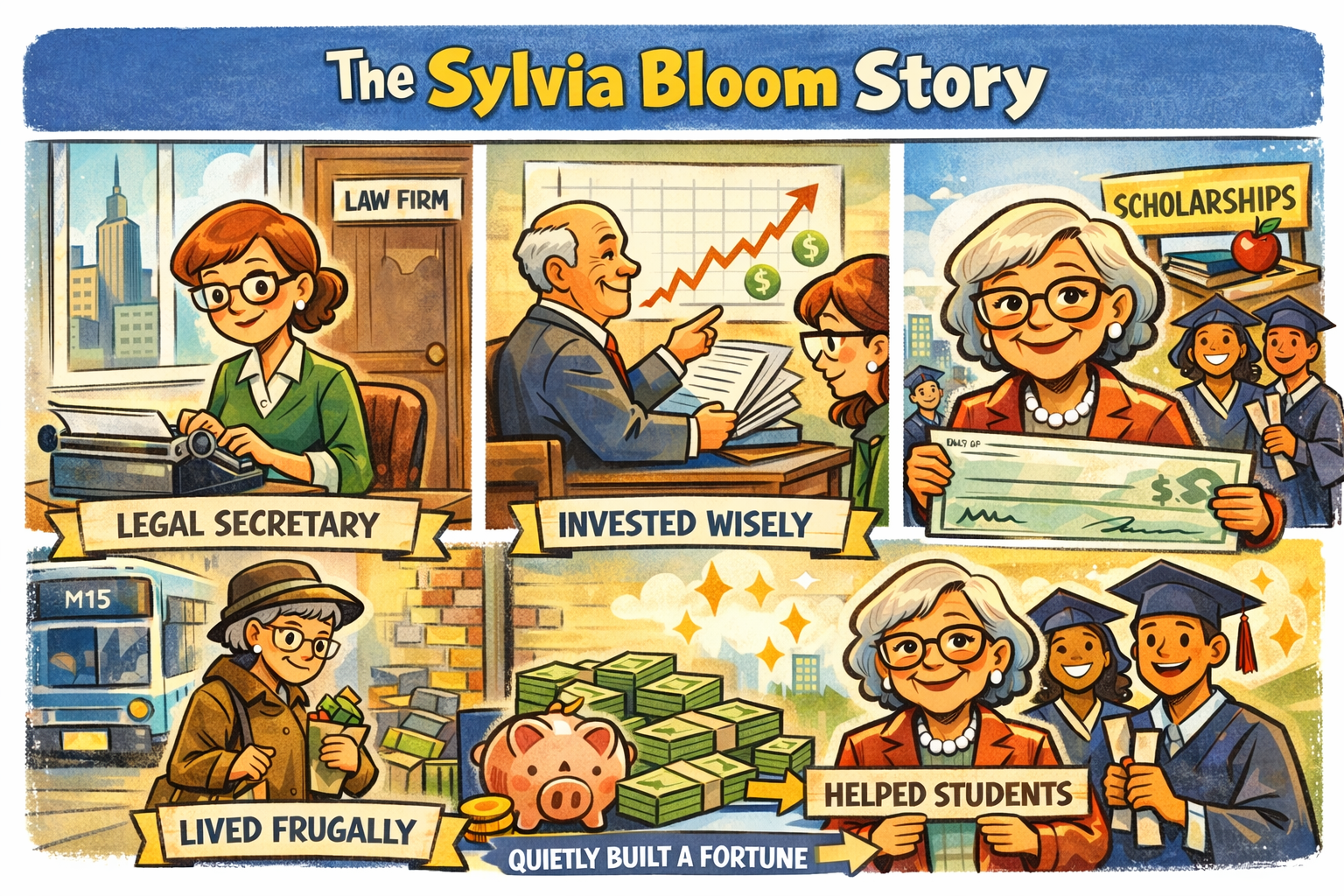
Sylvia Bloom was born in 1919 in New York and grew up in a working-class household. She did not attend university, or any other high-class educational institution. She became a legal secretary in Manhattan in the late 1940s.
In 1947, she began working at a law firm that would later become part of Cleary Gottlieb Steen & Hamilton, one of the most respected firms on Wall Street. She stayed in that role for over 50 years. (Remarkably, she apparently worked there for 67 years in total, right up to her retirement at the age of 96! She died shortly after.)
From the outside, there was nothing particularly unusual about her financial life. She earned a salary, lived modestly, and worked steadily. There was no public profile, and no attempt to “beat the market” in any conventional sense.
And yet, over time, something very unusual was happening in the background. She quietly used both time and her unique position as a secretary to her advantage.
Learning by observation
Working in a Wall Street law firm gave Sylvia Bloom a unique, if informal, education.
She was surrounded by partners and colleagues who invested in stocks. For the majority of her career, she worked closely with senior colleagues, managing their professional lives, and could see what they were buying; and, more importantly, she could see what they continued to hold. Rather than trying to develop her own elaborate strategy, she simply copied theirs.
When she saved money from her salary, she invested it in the same kinds of established companies her employers were buying – large, stable American businesses. Over time, she also reinvested dividends rather than spending them.
There was no attempt at timing markets. No frequent trading. No speculation on trends. Just imitation, patience, and repetition.
The power of doing nothing
The defining feature of Bloom’s approach was not what she did – it was what she did not do. She did not sell during downturns. She did not chase excitement during booms. She did not try to optimise or reinvent her portfolio every few years. She simply allowed time to do the heavy lifting.
This is where her story begins to resemble that of Ronald Read. Both were ordinary workers, who lived modest lives and invested consistently over decades. And both relied on dividend-paying, long-term holdings rather than speculation.
In Bloom’s case, the results were only discovered after her death in 2016, when it emerged that her estate was worth approximately $8–9 million. Much of this wealth was left to educational charities, with the largest portion going to the Henry Street Settlement (a long-established New York social services organisation that runs programmes including education and youth support for disadvantaged communities), and the remainder funding scholarships for low-income students in New York.
What actually created the wealth?
It’s tempting to look for a clever trick in stories like this, but there is very little mystery here.
Bloom’s wealth appears to have come from three simple behaviours:
- Consistent saving over a long period
- Investing in established, productive companies
- Reinvesting returns rather than withdrawing them
That’s it.
There’s no evidence of sophisticated market timing or high-risk concentration. Instead, the outcome was driven almost entirely by time in the market and behavioural discipline.
A more uncomfortable lesson
The more interesting implication of Bloom’s story is not about investing technique (because her investments were not necessarily well diversified – they just benefitted from compounding over a very long time). Rather, it is about attention.
Most people are exposed to investing as something active and difficult. It is framed as a constant series of decisions: what to buy, when to sell, how to respond to news, and how to outthink other participants. However, much of this resembles trading rather than long-term investing.
Bloom’s approach suggests something almost the opposite.
She treated investing as a background process rather than a constant activity. Once money was invested, it was largely left alone. In a sense, her real advantage was psychological rather than financial. She was able to avoid unnecessary interference.
Why these stories matter
Stories like Sylvia Bloom’s matter because they reset expectations. They are not about extraordinary intelligence or access. They are about what happens when ordinary behaviour is sustained for long enough without interruption.
Through her investing success, she won the psychological battle with her mind. She held on and just let her investments run. This demonstrates that the key quality to be a successful long-term investor is to master your emotions.
In a world that often rewards action and novelty, these qualities highlight the power of inaction and consistency.
For most people building wealth through regular income, pensions, or index funds, the lesson is not to copy Bloom’s exact holdings or strategy (her investment strategy was not well diversified – she did not invest in index funds, but rather individual stocks). It is to recognise the underlying principle: wealth accumulation is often less about intensity, and more about duration.
What the Sylvia Bloom investing story teaches us
In the end, Sylvia Bloom’s story is not really about investing at all. It is about consistency, patience, and the quiet removal of unnecessary noise.
She did not try to predict markets or find an edge. She simply worked, saved, invested, and repeated the same simple behaviours for over half a century. And in doing so, she joined a small but important group of people who demonstrate that financial success does not always require attention – it simply requires its absence.
For anyone trying to build long-term wealth today, that may be the most relevant insight of all.
I hope you found this article interesting. Here are some others you may also enjoy:
- The 4% Rule – how to know when to retire
- How to get rich as an employee
- Golden Rules for Career Success
- How I saved money on Airbnb using gift cards
- Overconsumption: Why We Consume Too Much
You can follow me on X, and find me on Pinterest, Instagram and Facebook.
Leave a Reply