
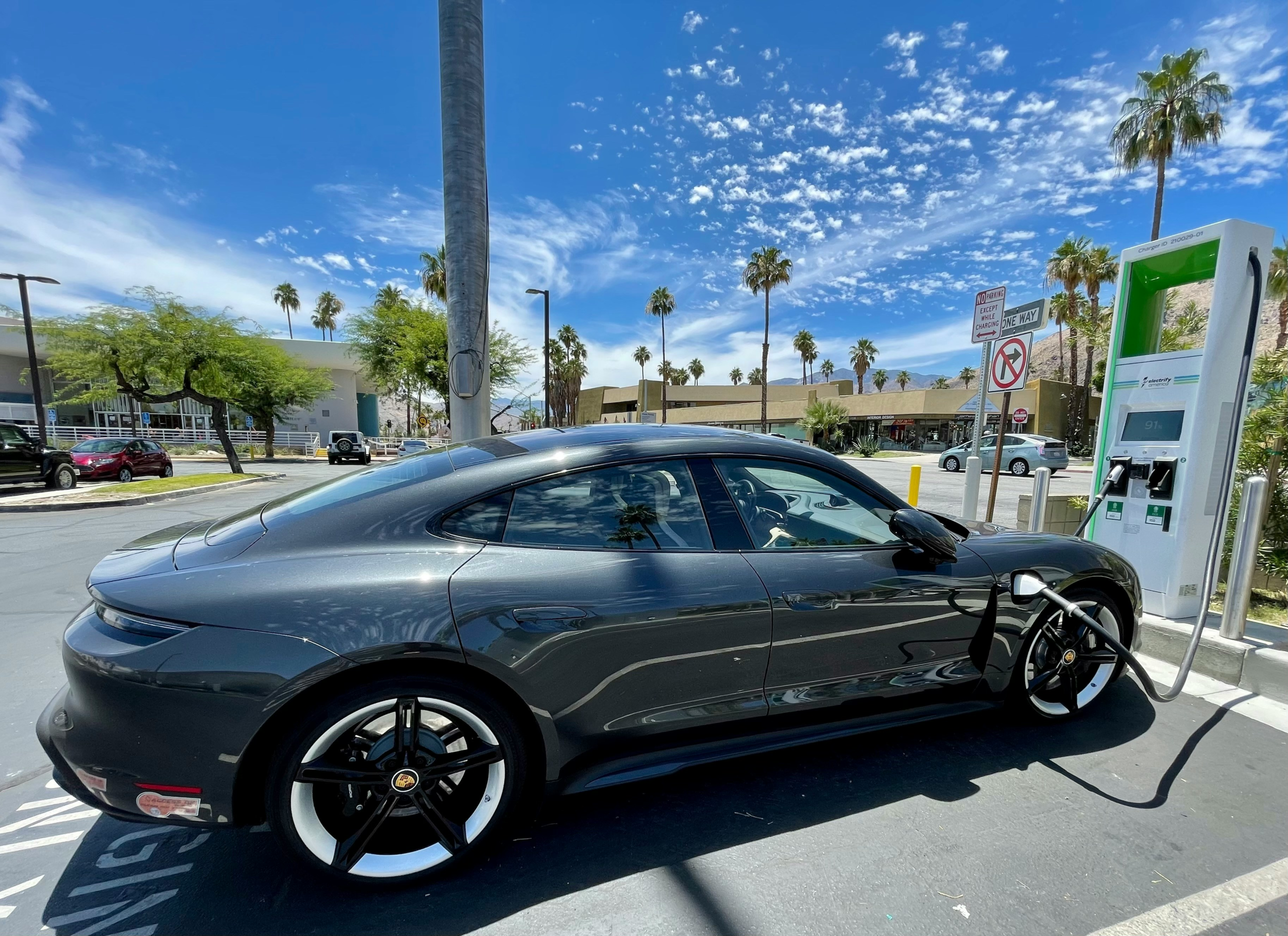
Are electric cars really better for the environment?
It’s a question that gets thrown around a lot – and the answer isn’t always as simple as it seems. Critics point to battery production and claim EVs are just as bad as petrol cars. But what’s the truth?
To understand it properly, we need context – and one of the best comparisons is something we rarely question: flying.
Planes are probably the most carbon-intensive way that people travel by, yet most of us think twice about switching to an electric car before we think about cutting back on flights. In this post, we’ll look at the data behind EV emissions, compare them to petrol cars and planes, and put everything into perspective.
I’m not Greta
First of all, I want to get one thing clear. While I’m passionate about protecting the environment, and very cognisant of humanity’s influence on the planet’s warming (my career has made this even more visible), I’m not Greta Thunberg. I’m not going to tell you to take a sailboat across the Atlantic in order to visit America, while only eating porridge and drinking rainwater.
But I am going to paint the facts clearly to you, so you can make an informed decision. The fact of the matter is this:
- Flying produces high emissions of greenhouse gases per relative distance travelled.
- If you are environmentally conscious, you have two options: fly less frequently and/or offset your flying with carbon credits or by planting trees.
Personally, I use a combination of both. I only fly once or twice per year, and I offset my own personal carbon emissions by planting trees with Ecologi. I don’t carbon offset individual flights as the tree planting I pay for covers my entire lifestyle – including the occasional flights I take.
Ecologi
I recommend Ecologi if you wish to carbon-offset your lifestyle. They are a UK-based company that started off as a tree-planting campaign for individuals back in early 2020, but have since evolved into a platform that helps businesses to measure & reduce their emissions, and report their progress towards net-zero. They focus on broad environmental and sustainability goals both in the UK and abroad, and also support improved education, climate resilient infrastructure, clean energy and water, better land use and improved wellbeing.

Ecologi are B-Corp certified and, in my opinion, an all-round great company. They are not a charity – rather a for-profit organisation that are governed and run in a fair and responsible manner.
Are electric cars better for the environment?
So, are electric cars better for the environment when you consider their full lifecycle?
In terms of lifetime CO2e (carbon dioxide equivalent) emissions, electric cars are getting cleaner and cleaner, as electricity grids see more renewable energy inclusion. This means greener electricity for EVs to run on, and so they need to be driven fewer miles to negate their relatively dirty production process (especially for the battery, which is very energy intensive).
There’s no doubt about it – EVs are cleaner than petrol, diesel or hybrid cars. The cleaner the national grid of your country, the cleaner your EV will be. In 2025, Great Britain’s National Grid saw roughly 36% of its electricity generation from wind and solar power, up from about 10% in 2015.
In the US in 2025, wind and solar power combined produced about 18% of electricity, with hydro power producing an additional ~6%. So the US grid isn’t quite as green as GB, but the USA is a massive area with multiple interconnected grids. Some regions of the US, like the Pacific Northwest and extreme Northeast (Vermont in particular), have a strong reliance on hydro power, while other areas (like Texas) have a high component of wind and solar power in their energy mix.
Either way, the point is clear – in most countries around the world, renewable energy is rapidly increasing in the energy mix. The initial resource consumption and CO2e emissions for an electric vehicle may be greater than for a petrol car, but the payback time is getting shorter and shorter.
Payback time of an EV
According to Reuters, it takes around 1 year for the total lifetime emissions of a Tesla Model 3 to be less than a Toyota Corolla based on the typical US electricity mix in 2021 – assuming driving 15,000 miles per year. For the cleaner UK grid, this will be around 8-9 months.
The key point is this: EVs start off dirtier, but get cleaner every mile you drive.
Planes produce a lot of CO2
In the UK, the average petrol car produces 143 g/mile CO2 (tailpipe emissions). Globally, CO2 per-seat per-mile emissions from passenger planes averaged ~140g/mile in 2022. Initially, this seems comparable to driving a petrol car. But then you realise the car figures are emissions for the whole vehicle – regardless of passengers – whereas for the plane, they are not.
Flying to Greece from London? That’s 3000 miles, equivalent to 420 kg of CO2 emissions per person, or 1.68 tons for a family of 4. You’d emit roughly 4x less simply driving your family in your petrol car to Athens rather than flying.
Of course, emissions vary significantly depending on the precise car and plane considered. We are just using industry-averaged ballpark figures here. The results, however, are stark – flying generally produces far more emissions, per mile travelled, than driving.
Because take-off and landing consume more fuel than cruising, long-haul flights are slightly more efficient than short-haul flights. Either way, the absolute emissions are huge, and would take you days or weeks of continuous driving to match.
Environmental impact of your holiday
Okay, so we’ve established that flying produces a lot of carbon dioxide, generally more than if you drove, and in a far shorter period of time. However, this still neglects the environmental impact of the rest of your holiday. Staying in a fancy hotel with a marble-floored lobby, plush carpets, room service, a pool/ gym and the greatest buffet of fresh food for breakfast, lunch and dinner that you’ve ever seen consumes a lot of resources.
You’re looking at around 10.4kg CO2e per room per night for a typical UK hotel. Go to Egypt, and you’re looking at around 45kg CO2e. For a 7-night holiday, that’s 72.8kg for a holiday in the UK, and 315kg for a holiday in Egypt. And these figures are just for staying at the hotel. They don’t include any additional excursions or driving you do.
Taking a fancy holiday is bad for the environment. No way around it.
Don’t listen to me, listen to your conscience
I’m not here to preach that you should never go on holiday again. I’m just doing the research and stating the facts, plain and simple. You may not like them, but the truth is that flying and the global tourism industry are not sustainable. They can be made more sustainable if you are willing to spend more money to personally offset the CO2 emitted, and by choosing more sustainable travel/ accommodation, but most people choose not to.
Look, I’m still going to go on holiday, and even fly places. And you should too. But at least, having read this blog, you’re more aware of the environmental impact of that decision. That’s my job and if you’re aware then I’m happy. You may decide to offset some of the carbon emissions, like I do – but that is a totally personal decision and not something I would ever enforce.
Maybe you’ll take more holidays domestically here in the UK, or take the train into Europe rather than flying (which can reduce your emissions by up to 90%). Perhaps you’ll start driving an EV to reduce emissions – the UK’s electric vehicle charging network is rapidly expanding to support this movement.
Just realise that any resource-intensive activity you do – like going on holiday – will have an impact on the environment. You shouldn’t be ignorant to this. Electric cars aren’t perfect – but compared to the alternatives, they’re a meaningful step in the right direction.
FAQ
Yes, over their full lifecycle, electric cars are much better for the environment than petrol or diesel. While their production is more energy (and carbon) intensive – especially battery production – EVs produce far lower emissions during use. As electricity grids become greener, the environmental advantage of EVs continues to grow – making them a more sustainable long-term choice.
Most electric vehicles offset their higher production within a year of driving, depending on mileage and the energy mix of the electricity grid. After this point, they continue to produce significantly fewer emissions than petrol cars, meaning the longer you drive an EV, the greater its environmental benefit becomes.
While there are zero tailpipe emissions from electric cars, they are not completely emission-free. The manufacturing process generates emissions (especially the battery production), and there are some emissions from the electricity mix if fossil fuels are used. However, these emissions are much lower over the vehicle’s lifetime compared to petrol or diesel cars, especially in countries with cleaner energy grids.
Yes, generally. Even an efficient plane will generate at least as many CO2e emissions as driving a petrol car. Putting more people in the petrol car (spouse, kids), will reduce per-person emissions even further when driving – making flying a much less sustainable choice.
The cleaner the electricity grid, the lower the emissions associated with charging an electric vehicle. Countries with a high proportion of renewable energy sources make EVs significantly more environmentally friendly. As grids continue to decarbonise, electric cars will become even cleaner over time.
I hope you enjoyed this article. Here are some others you may also like:
- Why you need to consume less
- Cycle more to save money (and get fit)
- Why you need to embrace discomfort
- How to get a good night’s sleep
- Make hay while the rain pours
You can follow me on X, and find me on Pinterest, Instagram and Facebook.
Leave a Reply