
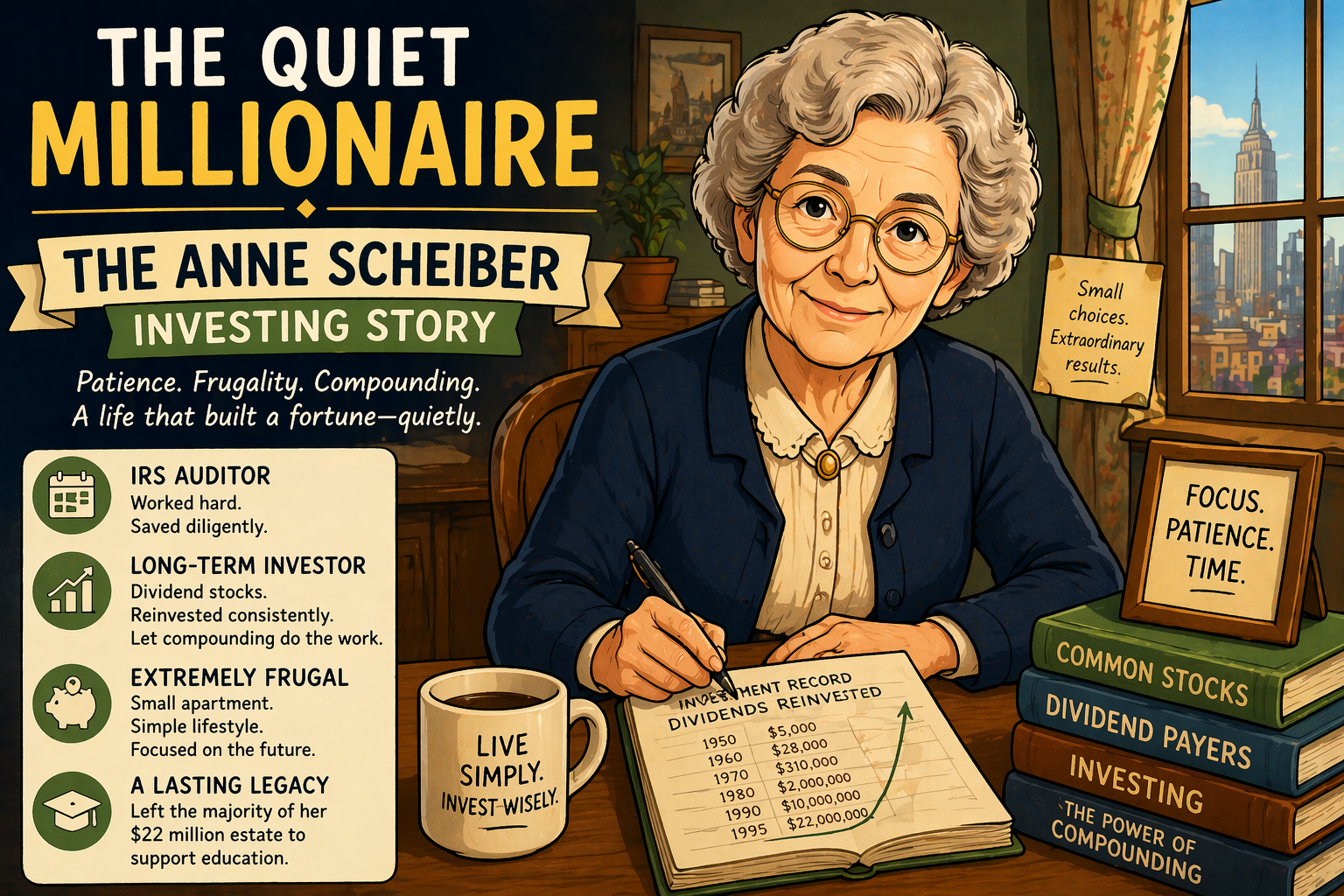
The Anne Scheiber investing story is another compelling example of what long-term investing can achieve when paired with patience and discipline. Like several of the “quiet millionaires” explored on this site, she built significant wealth without a high income, and without any attempt to outsmart the market.
I wanted to share this story because, as a Jewish woman, Anne Scheiber experienced discrimination throughout her career. There is a sense that her financial success came not only from consistency, but also from a deep reluctance to spend, trust, or rely on others. This raises a broader question that sits just beneath the Slow Down and Save philosophy: not how to build wealth, but how to effectively use it as a tool to live your rich life.
Difficulties early in life
Scheiber was born in 1893 in New York City, and spent much of her working life as an auditor (a federal employee who examines tax returns to verify accuracy and compliance with tax laws) for the Internal Revenue Service. She was an intelligent and highly capable employee, but her career was marked by frustration.
She was repeatedly ignored for promotions (likely a result of misogyny and (perhaps) anti-Semitic bias). By the time she retired from the IRS in 1944, at the age of 51, she had a retirement savings pot worth ~$20,000 (although sources differ), which was already invested in established American companies.
She never earned more than $4,000 in a single year during her employment in the IRS. (Note that $20,000 in 1944 is worth approximately $375,000 in March 2026 dollars.) That’s a decent chunk of money, but hardly enough for a comfortable retirement (especially in the US, which has a higher cost of living than the UK).
Building wealth quietly
After her retirement, what followed was not a dramatic shift, but a continuation of the same careful, methodical approach to money that had defined her working life. She continued to invest in established American companies, supported by a modest $3,100 annual pension, and focussed on those that paid reliable dividends. She always reinvested those dividends, and made no attempt to time the market, never traded frequently, and tried to keep her investment approach as simple as possible.
She just allowed her portfolio to grow steadily in the background.
Anne Scheiber lived to the age of 101, and so had a 50-year retirement. That’s a long time for compounding to take place. By the time of her death in 1995, her portfolio had grown to approximately $22 million (worth approx $47.7 million in March 2026 dollars). From a purely financial perspective, this is a textbook example of what long-term investing can achieve with dollar-cost averaging and time on your side.
Frugality taken to the extreme?
What makes her story more difficult to interpret is not the investing itself, but the way she lived alongside it. Scheiber was known for her extreme frugality, even by the standards of the time. (This was likely influenced by her early adulthood living through the Great Depression.) She had an incredibly high savings rate while she worked – as high as 80%. Deflation during the Great Depression meant that even small amounts of money went a long way.
She lived in a small, rented apartment, avoided unnecessary spending, and maintained an essentially unchanged lifestyle for many decades. She never married or had children – which simplified her finances – and wore the same clothes for decades, never updating her furniture. There was no visible shift towards a more comfortable lifestyle as her wealth increased.
Such a level of discipline is admirable, even if taken to the extreme as here. In a culture that encourages consumption, there is something very impressive about a person who resists those pressures so completely. But there is also a question of balance. Building wealth through investing is a means to an end, not the end in itself. When taken to the extreme, the process can limit rather than enhance the quality of life.
Independence or isolation?
There are some suggestions – though not definitive conclusions – that Scheiber became increasingly isolated over time. She kept her financial life almost entirely private, and some accounts describe her as distrustful – perhaps shaped by her experience in the workplace. Others simply portray her as independent. The full picture is difficult to reconstruct, and it would be unfair to draw firm conclusions.
A quiet legacy
Her wealth could not remain hidden forever, however. Upon her death, she left the vast majority of her estate to support education, most notably through scholarships for women at Yeshiva University. She redirected the result of an entire life of restraint and patience into creating opportunities for others in a way that she didn’t get to experience herself.
What the Anne Scheiber investing story teaches us
From an investing perspective, the lessons are familiar but worth restating. Time, consistency and reinvesting dividends are powerful forces, particularly when combined over multiple decades. Scheiber’s success did not come from complex strategies or exceptional insight, but from a willingness to stay the course and let compounding do the work.
But there is an equally important second layer of insight here. Her life raises questions about how wealth is used, and what role it should play while it is being accumulated. It highlights the tension between future wealth accumulation and living life in the present – and the risk of focussing so heavily on one that the other is neglected.
Concluding thoughts
Anne Scheiber’s story demonstrates with remarkable clarity what can be achieved through long-term investing, even starting from modest means. At the same time, it gives a more personal reflection on what that wealth is ultimately for. Her approach was defined by discipline, independence and an almost complete resistance to consumption.
For the Slow Down and Saver, the story is both inspiring and cautionary. Yes, we should be building (significant) wealth through investing. But what will you then do with that wealth? Would you rather live a sustainable life of experiences and generosity, or pass away with a large number in your bank account?
Building wealth is a means to an end, not the end in itself.
Perhaps the most useful takeaway is not to judge her choices, but to recognise the trade-offs they represent. Building wealth requires patience and restraint, but living well also requires a willingness to use what has been built. The challenge is in finding a balance between the two.
Thank you for reading this post. I hope you enjoyed it. Here are some others you may like:
- Don’t Dance with the Stock Market
- THIS is why investing is better than saving
- Why your £4 coffee actually cost £360
- How to Invest in the Stock Market for Beginners (a Simple UK Strategy)
You can follow me on X, and find me on Pinterest, Instagram and Facebook.
Leave a Reply