
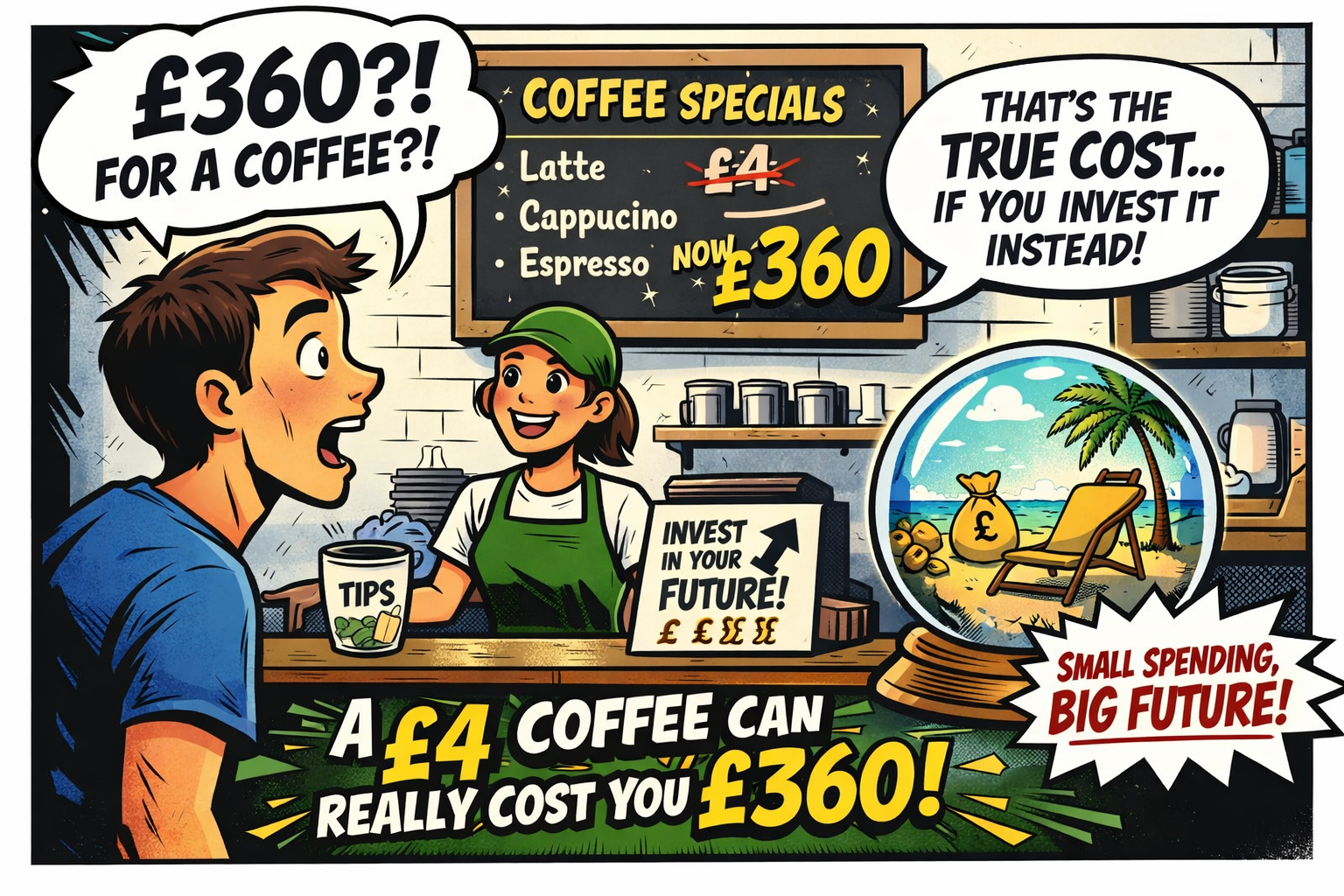
Whenever I go out and find myself considering to buy a Costa coffee or a Greggs vegan sausage roll, I stop myself and consider how much money I’m really spending. And it’s not just a few quid either – the true cost of everyday spending is far more than most of us realise.
But to understand, you have to shift your perception of what money means to you. Is it something to be spent straight away with no thought to the future, or is it a tool you can use to unlock financial freedom over the long term? You see, your £1.50 Greggs vegan sausage roll actually cost you £135, and your £4 Costa coffee cost £360. It’s all about perspective, and understanding the true cost of everyday spending.
Do you have a long-term mindset?
I hope, as a Slow Down and Saver, you’ve built a strong set of principles around investing and building wealth over the long-term. This requires consistently putting money into the global stock market from your monthly pay check. This process smoothes out the short-term market volatility, and is known as pound-cost averaging. So invest your money now and in x number of years, it will be worth more. But how much more?
Well, it turns out, quite a lot more. If you invest your money into the global stock market, you can expect growth of ~9% per year, on average:

When we invest, we should have a long-term mindset. And I’m not talking about 20 or 30 years here. No. Let’s be bold and think about a 50-year horizon. This works nicely for the person in their early 20s who wants to build a secure financial future for themselves – and so starts investing in index funds. Even if you started investing at age 40, you could still be alive and well after the 50-year horizon if you follow the principles laid out in this blog on how to live a healthy life.
After all, who doesn’t want to be ambitious with their goals? When I invest, I want most of my money to be invested for a 50-year time frame. Yes, it’s possible I’ll have to withdraw some earlier, especially if I want to retire early, but I’d like to think most of it will stay invested for a half century. So, no measly 20 or 30-year time frame for me. Let’s be ambitious and go for 50 years.
The true cost of everyday spending
Perhaps you can see where I’m going here. If my money stays invested for 50 years, anything I invest now should eventually be worth 90 times that. So, when I stop myself from buying a packet of Goji berries in the supermarket (as I did last weekend, at a cost of £3.90), I’ve actually saved my future self £351 – because I will now be a good boy and sock this money into my Vanguard investment accounts rather than buying something else that’s unnecessary.
This is the opportunity cost of spending your money now and not investing. This is how I think of my discretionary spending – what am I costing my future self? Of course, your current self deserves some luxuries too, but there has to be a happy medium in there where you’re willing to cut down on optional spending now to enable yourself a much wealthier future. By recognising the true cost of everyday spending, you can redirect money into long-term investments instead of fleeting pleasures.
Even if you think 50 years is too long an investing timeframe, consider this: after 10 years, your money would be worth 2.5x what you invested, after 20 years around 6x more and after 30 years around 15x more. Even with shorter investing horizons, your money still has massive wealth-building potential. You just need some perspective.

The cost of something isn’t just its price tag. It’s the future wealth you give up by spending money instead of investing.
Is this why we can’t have things?
Taylor Swift may have said it but no, you shouldn’t completely deprive yourself of nice things in the present to enable a wealthier future. On the very extreme end, it is possible to do this; indeed, Jacob from Early Retirement Extreme managed reduce his spending to $8,000 USD per year and retire to a life of extreme frugality. This is not for everyone and I’m not suggesting you need to follow his approach (although it certainly wouldn’t hurt to utilise some of the tools he talks about in his blog).
What you do need to do, is to be more conscious with your spending. Consider the opportunity cost of not investing. Money spent now is gone forever. Perhaps this will encourage you to spend less on discretionary items that probably won’t make you any happier anyway. Instead you can use it to buy the ultimate gift – financial freedom.
Imagine a world where money no longer concerns you. Through consistent investing and reducing your expenses, you’re able to live without worry about money. You may not be rich, but you’ll certainly be wealthy in health, time and money. Now this, surely, is the ultimate goal.
It works for your income too
The reason why people stay poor is because their discretionary spending is too high. But it doesn’t have to be like that. Using the power of 90x thinking, you can take a completely different mindset about any pay rise or bonus you get.
Let’s say you get a £5,000 pay rise at work (after tax). You understand the opportunity cost of not investing, so instead you decide this needs to be put into a low-cost index fund tracking the global stock market. At 9% per year average return, this would be worth ~£450,000 after 50 years (or around £30,000 after 20 years). As Charlie Munger (once-Vice President of Berkshire Hathaway) said, “The big money is not in the buying and selling, but in the waiting.”
Conclusion
The true cost of everyday spending goes far beyond the price tag. Every cup of coffee or snack you buy carries an opportunity cost – the potential wealth you forgo by not investing. By shifting your mindset from short-term gratification to long-term growth, you can make small, intentional choices that add up to financial freedom. Even modest savings, consistently invested, compound into significant wealth over decades. It’s not about depriving yourself, but about being conscious of your spending and using money as a tool to unlock a richer, more secure future. Start small, think long-term, and let your future self thank you.
FAQ
This is the future value you give up by spending money now instead of investing it. Even small daily expenses, like a £4 coffee, can grow significantly over decades. Choosing to invest that money instead could contribute thousands of pounds to your long-term wealth and financial freedom.
90x thinking encourages you to consider the exponential growth of invested money over decades. For example, money invested today could potentially grow 90 times over the next 50 years. This mindset helps you make conscious decisions about discretionary spending, prioritising investments that build lasting financial security rather than short-term pleasures.
Consistent investing of even modest amounts compounds significantly over the long-term. For example, investing £1–£5 daily may seem small, but over decades, this builds into a sizeable nest egg. The key is consistency, patience, and reinvesting returns to harness the power of compound interest effectively.
Start by tracking discretionary expenses and consider their long-term impact if invested. Ask yourself: “What would this cost me in 10, 20, or 50 years?” Small lifestyle adjustments, like reducing unnecessary coffees or snacks, can redirect funds into investments, boosting financial independence while still allowing occasional indulgences responsibly.
I hope you enjoyed reading this post. It was pretty fun to write. Here are some other posts you may like:
Why you need to keep your investing fees low
The shocking truth of the UK’s investing landscape
The unexpected benefits of lifting heavy weights
Retire early by not being a moron with your money
2025 review – the year of Life
You can follow me on X, and find me on Pinterest, Instagram and Facebook.
Leave a Reply