
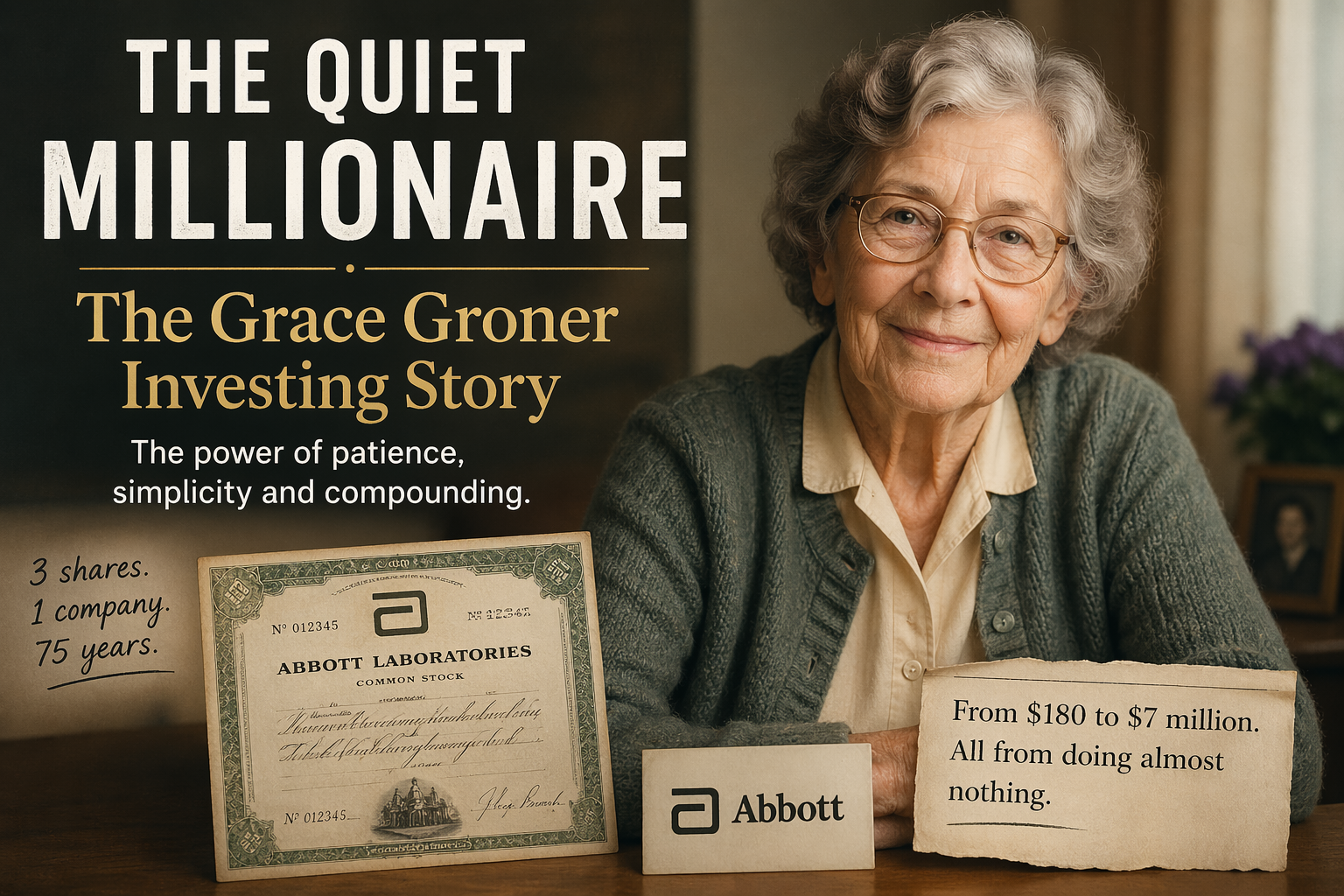
The story of Grace Groner really is a remarkable one. It is an example of an incredibly successful investing career based not on good decisions, but a lack of them. It is not a story of complexity or constant optimisation, but of patience, consistency and the quiet power of holding on.
A simple beginning
Grace Groner was born in 1909 in Illinois, USA, and spent most of her working life as a secretary at Abbott Laboratories. She never earned a high salary, and lived in a small one-bedroom cottage. She was known to be frugal, careful with money, and content with very little.
There was nothing about her life that would suggest extraordinary wealth – and yet, by the time of her death in 2010, her estate was worth around $7 million.
The entire strategy: buy, hold and hold
What makes Groner’s story so impressive is that she basically did nothing with her investments. In 1935, she purchased three shares of Abbott Laboratories stock for $180 in total. From that point on she simply held the shares, reinvested the dividends and did not sell.
Over time, stock splits increased her share count, and dividend reinvestment steadily compounded her position. Year after year, decade after decade, she let the investment grow quietly in the background. The skill of doing nothing with your investments takes guts – especially when taken to the extreme like this.
The real driver behind her successful investments was time, not brilliance
It is tempting to view this as a story about being able to pick the perfect stock (more likely, this was just good fortune in the case of Grace – she happened to work at a company that would continue to grow and perform exceptionally well over the coming decades).
In a different world – where just a few variables had changed – things may have turned out differently. Perhaps there were different interest rates by the US Federal Reserve, a scandal involving senior management which got investors doubting or the unfortunate early death of the brilliant CEO. But for Grace, Abbott Laboratories was the perfect company.
You see, plenty of people have bought good, even great companies in the past. But very few have held them for 70+ years without interruption. The real driver of Groner’s fantastic wealth was not good selection – it was duration. She allowed compounding to work over an extraordinary length of time, without interference.
Holding for such a duration is incredibly rare.
Most investors interrupt the process:
- Sell during downturns.
- Chase new opportunities.
- React to headlines.
- Try to optimise.
Each of these actions breaks the chain of compounding. Grace Groner did the opposite – she left it intact. As John Bogle once said: “Don’t just do something. Stand there!“
Why didn’t she spend it?
It’s easy to look at her $7 million estate and assume she could have spent more, travelled more, or lived more comfortably. After all, she did hold on to those shares for 75 years – was there any need to?
Such an interpretation is easy to make, but remember that it assumes enjoyment is tied to spending.
Grace Groner lived a simple life that suited her. She was financially secure, had independence, avoided financial stress, and gave generously. She did not deprive herself in pursuit of wealth – rather, she did not define her enjoyment through consumption. This is an important distinction.
For some people, money is a tool for spending and for lifestyle expansion. For others, like Grace, it is a tool for peace of mind and freedom from worry. This is very much in line with the Slow Down and Save philosophy.
A quiet act of generosity
The most meaningful part of her story came at the end. When she died in 2010, she left the majority of her fortune to fund scholarships for students in need. Her donation established a scholarship programme at her almer mater, Lake Forest College in Illinois, helping generations of students access education who might otherwise have struggled to afford it.
In doing so, her lifetime of patience and restraint was converted into opportunity for others.
What can we learn?
There are a few clear lessons from this story – but they are behavioural, not technical.
- Time is on your side. Compounding does not need brilliance. It needs time; the longer the runway, the more powerful the outcome.
- Simplicity often wins. Her strategy would be considered too simple (and perhaps dangerous) today. But simplicity has one big advantage: it’s easier to stick with.
- The real challenge is behavioural. The hardest part is not choosing investments – it is leaving them alone. Avoiding unnecessary action is often what separates long-term success from average outcomes.
- Wealth does not need to be consumed to be meaningful. She used it to build financial security during her lifetime, and provide opportunity for others after it.
What can we not learn?
Groner’s strategy (holding a single company for many decades), is not a strategy you should copy. While it worked in her case, it involved significant concentration risk. (The potential for significant losses in an investment portfolio due to over-exposure to a single asset, sector, or geographic region.)
The Slow Down and Save approach involves buying globally-diversified index funds consistently every month. This can still capture long-term compounding, but avoids the concentration risk.
At first glance, Grace Groner’s story might suggest “buy one stock and hold forever”. However, this is not what we should take away. Rather, the lesson here is to “buy productive assets (in our case shares from thousands of global companies), and give them time to grow”.
Closing thoughts
Grace Groner did not build her wealth through insight, timing or complexity. Rather, she built in through tremendous patience, and – let’s face it – a good dose of luck. She made one good decision, and then had the discipline not to interfere with it for the rest of her life.
In a world that constantly encourages action, optimisation and change, her story is a reminder that sometimes the most effective strategy is the simplest: hold, hold and keep holding.
I hope you enjoyed this post. Here are some others you may also enjoy:
- Live a Simple Life and Save a Ton of Money
- How to make the most of your ISA
- How to be a Badass at Life
- Is a Career a Wasted Life?
You can follow me on X, and find me on Pinterest, Instagram and Facebook.
Leave a Reply