
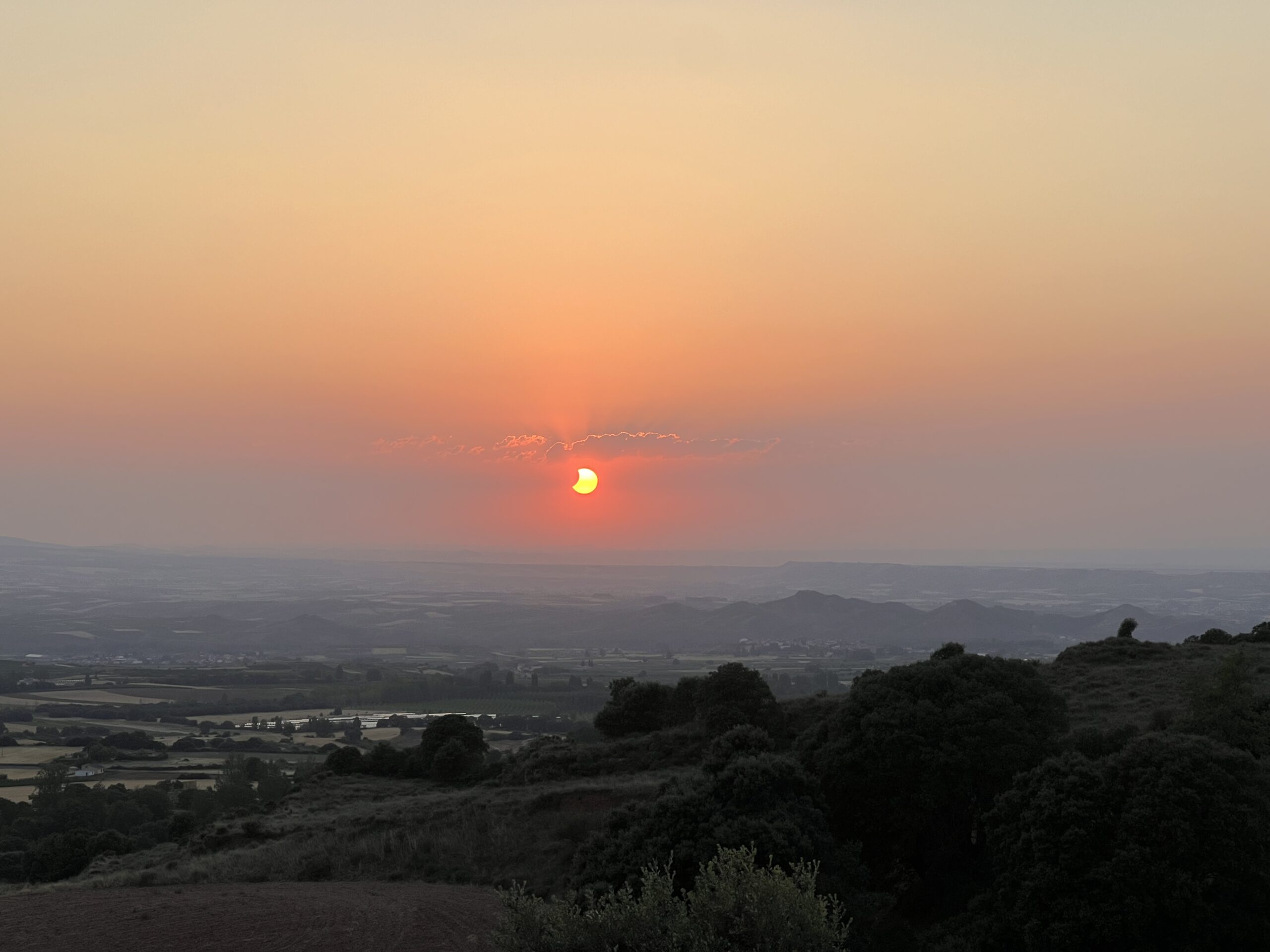
Back on August 9th, I drove my own car from home in Aylesbury to Plymouth, to catch the overnight ferry to Santander. Thus began an epic 9-day adventure across a land of; mountains and forests, deserts and plains; cathedrals, monasteries and castles, all to stand in the shadow of the Moon.
In my life, I’ve stood in the Moon’s shadow for a total of 6 minutes and 51 seconds, during three separate total solar eclipses. And let me tell you – the profundity of the moment – literally seeing the mechanics of the solar system in action with your own eyes, and being reminded of how insignificant you, as an individual, are on such scales – never changes. It’s a moment when people may shout in jubilation (me), clap and cheer, cry and hug those dear to them or simply say nothing just stare in awe.
It’s fantastic. It’s beautiful. One of the great natural spectacles.
I truly believe the world would be a much better place if everyone was able to witness at least one total solar eclipse during their lifetime. Your worries seem more trivial once you’ve seen one.
Even better was that I got to witness the spectacle with some of my dearest friends. You just can’t beat an epic road trip across Spain with your best buddies to witness the Moon pass in front of the Sun!


Totality occurred only ~ 45 minutes before sunset, so there was a cool contrast with the eclipsed Sun and the Earth’s horizon which I’ve never seen before. You could see the Moon’s shadow passing over the Earth’s atmosphere during totality. There was a bonus spectacle at sunset, too – as can be seen in the thumbnail image for this post, the Sun was still partially eclipsed – and because of the extremely low angle, we were able to get unfiltered views and photographs of it.
We were fortunate to have clear skies for the eclipse – but this is pretty normal for central Spain in August. We paid for it with the heat though – temperatures earlier in the day were over 40 Celsius!
With the eclipse being in the evening, and, in this part of Spain at least, totality occurring south-west of the main population centre (Pamplona, which was where we were also staying). There was a lot of one-way eclipse traffic heading back into Pamplona well into the night, and it wasn’t until almost 1 am that I finally got to sleep.
And I would need all the sleep I could get, as it was a 7am departure for Barcelona the next day, which was 306 miles away. It wasn’t a particularly relaxing drive either, as we had a 3pm guided tour of Sagrada Família to get to. This involved driving right into the city centre, while making sure we had the correct foreign vehicle and low-emissions certifications.
Sagrada Família is a beautiful basilica, and we were fortunate that only weeks previously, building work on all the major towers was completed – with the central Tower of Jesus Christ being officially blessed and opened on June 10th 2026.
One of the memories which will stay with me from the visit are the Spiral Staircases of Death within the Nativity Towers. If you’ve ever read Dan Brown, you might be interested to know that an important scene happens in these spiral staircases in his book Origin.

Here’s how the front facade of the basilica looks as of August 2026:

The stained glass windows on the north-east and south-west sides of the basilica are designed to allow beautifully coloured light into the cathedral in the mornings and evenings. Here’s how the glass catches the late afternoon light at around 17:50 local time:

A couple of days later, myself and some of the group ascended the Montserrat mountain range, located around 30km inland from Barcelona. This is a very strange mountain range, with – from a distance – remarkable rounded and smooth surfaces, rising to a peak of 1,236 m at Sant Jeroni. Upon closer inspection, I was surprised to find that the mountains are composed of a conglomerate rock, rather like concrete, laid down as continuous sediment deposits from the River Ebro around 15-35 million years ago gradually compressed and solidified. So, in geological terms, the mountain range extremely young.

Montserrat is also home to a famous monastery of the same name, high up on the mountain. We visited this too – it is 1,001 years old!
And with that it was a drive back north to Santander, through the great wilderness of interior Spain. The Iberian Peninsula is massive, about 2.4 times larger than the UK, and the combined population of Spain and Portugal is ~ 10 million lower than the UK (~60 million vs ~ 70 million in the UK). Apart from Madrid, most people in Spain live on the coast, so that leaves much of the interior sparsely populated.
Unlike the UK, there is a lot of land in Iberia that is unused – just scrubland, mountains and deserts. This was the main thing I noticed about interior north-eastern Spain – the vast expanses of vague agricultural land and then nothingness. Great places to put massive solar farms! There is also a fantastic climatological and biodiversity change as you traverse north/south over the northern Cantabrian mountains towards the north coast – changing from semiarid plains to rich wooded hillsides and valleys in just 50 miles or so.
On another note, the electric charging infrastructure in central north-eastern Spain is not great, in some places having to drive 60+ miles on the main motorways before you come across charging of any sort. But absolutely no issues if you plan ahead – Tesla Superchargers work seamlessly across the UK and all of Europe, while I also had easy access to third-party public chargers through my Octopus Electroverse card.
The ferry that travels between Plymouth and Santander – the Pont Avon – operated by Brittany Ferries, can carry up to 650 cars, and features many amenities, including two large restaurants, multiple bars, a performance area, pool, two cinemas, shopping and a spa. And that’s a good thing too on a 22 hour crossing. If you’re lucky, you may spot marine wildlife, including whales and dolphins, and you may get some beautiful sunrises and sunsets. Just hope for good weather – a rough crossing would be miserable – and make sure to book a cabin! There’s nothing worse than having nowhere proper to sleep.

Would I go on a road trip through Spain again? Yes, but never in the summer – it’s just too hot. Taking the ferry adds on another 2-3 days to the trip – so this only works if you have lots of time available.
Now just keep quiet about the total solar eclipse over southern Spain on August 2nd 2027!
- Can a Cheap Index Fund Really Beat the World’s Best Investors?
- Vanguard lowers fees again!
- The $8 Million Janitor
- Why Discipline and Consistency are the Ultimate Life Skills
- How to not die early
You can follow me on X, and find me on Pinterest, Instagram and Facebook.
Leave a Reply