
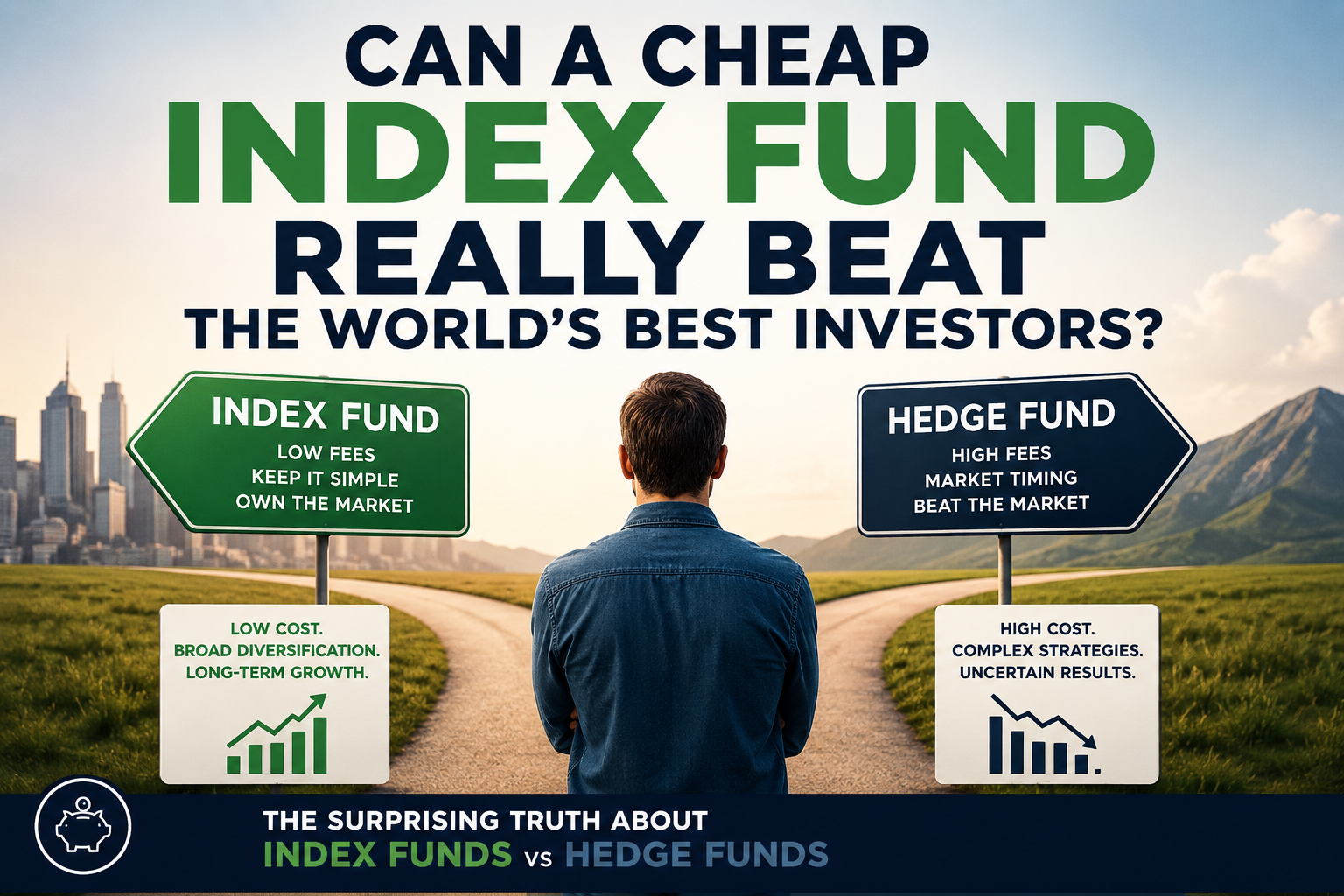
If I offered you a choice between two investment managers, who would you pick?
The first is a team of Nobel Prize winners, mathematicians, economists and Ivy League graduates. They have access to cutting-edge technology, expensive research, private company meetings and decades of investing experience. They charge handsomely for their expertise, but surely that’s because they’re worth it.
The second option is… nobody.
No analysts, no stock picking, no market timing. Instead, it simply buys every company in a stock market index and quietly sits there, charging an annual fee so small you don’t even notice it.
Surely the first option wins?
Well, as we shall see below, perhaps not…
What is an index fund?
An index fund is one of the simplest investments ever created.
Rather than trying to identify tomorrow’s winning companies, it simply buys every company in a chosen index. If Apple, Microsoft, Nvidia and Amazon become larger companies, the fund naturally owns more of them. If another business declines, its weighting gradually falls.
There is no crystal ball. No heroic predictions. No frantic buying and selling.
Funds such as Vanguard’s S&P 500 ETF (VUAG) simply own the 500 largest listed companies in the United States. Meanwhile, the Vanguard FTSE All-World ETF (VWRP) owns thousands of companies across both developed and emerging markets, giving investors exposure to businesses around the globe.
The philosophy is refreshingly simple: if capitalism continues to create wealth, you’ll own your share of it. This simplicity keeps the fees very low, currently 0.07% for VUAG and 0.19% for VWRP (these are on top of Vanguard’s platform fees, which are capped at £375 per year).
What is a hedge fund?
Hedge funds occupy the opposite end of the investing spectrum.
Rather than following an index, hedge fund managers actively search for opportunities to outperform the market. They might buy undervalued companies, bet against overvalued ones, trade currencies, use leverage, analyse mergers, or employ complex mathematical models (and sometimes do all of these).
The hedge fund industry represents the top tier of finance, and offers massive salaries to attract some of the most intelligent people on the planet to work for them.
Naturally, this expertise comes at a price.
Traditionally, hedge funds charged what became known as “2 and 20” — a 2% annual management fee plus 20% of any profits generated. While fee structures have become more competitive over recent years, hedge funds still charge very high fees for their skills.
Fees matter more than most people realise
Every pound paid in fees is a pound that can no longer earn returns next year, and the year after, and the year after that… Over decades, small differences compound.
Unlike market returns, choosing a low-cost investment is entirely within our control. It is probably the single most important factor in determining portfolio growth over time.
Because of this (and also because most active fund managers can’t beat the market), in the 15 years to year-end 2025, 90% of large cap US mutual funds underperformed the S&P500 index. Of course, this is specifically pertaining to mutual funds – rather than hedge funds.
Unlike traditional mutual fund managers, many hedge funds aren’t actively trying to beat the market every year. Rather, they are trying to smooth the ride for their investors. So, in some sense, a direct comparison is unfair. But hedge funds are really a private investment club only available to the world’s elite. So compare them we shall.
Index funds vs hedge funds; who actually wins?
We hit a barrier here; hedge funds are generally opaque – and sometimes downright secretive – about their performance. Through a combination of educated guesswork, and using what information is actually available, we can say that, if your goal is to grow wealth over decades, the evidence strongly favours low-cost index funds.
A lot of this is due to fees – but some is due simply to the fact that the stock market is highly efficient, and it is becoming increasingly difficult to find undervalued opportunities. Finding bargains that everyone else has missed is much harder than it sounds, even for the world’s best hedge funds.
A great visual showing hedge fund vs S&P500 performance can be found here (very difficult to reproduce this graphic without a copyright infringement, plus the hedge fund performance index is behind a paywall). However, it’s clear that the S&P500 outperforms the average hedge fund by 5-10% per year.
Warren Buffett settles the argument
In January 2008, Warren Buffett made a million-dollar bet with Protégé Partners that a low cost index fund (Vanguard’s S&P 500 Admiral fund (VFIAX)) would outperform a careful selection of five top hedge funds over the following 10 years.
Buffett easily won – stating that the results for the hedge fund investors were dismal – really dismal.” And he noted that the “2 and 20” fee structure generally adopted by hedge funds means that managers were “showered with compensation” despite, often enough, providing only “esoteric gibberish” in return.
Some hedge funds have consistently outperformed the market. The problem is that almost nobody can invest in them. Indeed, for ordinary investors like you and me, they may as well not exist. Many of these top hedge funds are either closed to new investors, have insanely high minimum investments, or primarily serve ultra-high-net-worth individuals.
Barriers for the ordinary investor have broken down
The realistic investing decision for most ordinary investors is between an inexpensive index fund and the actively managed alternative (mutual fund). In that comparison, passive investing has a remarkably strong track record.
At least index funds are now more accessible to the ordinary investor than ever before. Fifty years ago, building a globally diversified portfolio required substantial wealth and often a professional advisor – with annual fees usually in the 1-2% range. Today, anyone can buy thousands of companies around the world through a single index fund, and for annual costs measured in fractions of a percent.
My own approach
I invest every month into a low-cost global index fund (generally the Vanguard FTSE All-World ETF (VWRP)), because I’ve become convinced that simplicity is underrated.
I’d rather not compete against millions of professional traders who try to predict what the stock market’s going to do next for a living. Instead, I’d rather own the market, keep my costs low, invest consistently, and allow time to do the heavy lifting.
Final thoughts
The next time you hear about billion-pound hedge funds employing armies of analysts and charging eye-watering fees, remember that the smartest investment is usually the simplest. Buy thousands of great companies in a single index, pay almost nothing in fees, and then sit back and watch the money roll in.
Remember: if in doubt about your investments, do nothing.
I hope you enjoyed reading this post. Here are some others you may enjoy:
- EVs are cleaner than you think
- Why additional contributions into a large portfolio don’t matter
- Why £200k is investing’s magic number
- Is a Career a Wasted Life?
- The Best Way to Spend Tesco Clubcard Points (February 2026)
You can follow me on X, and find me on Pinterest, Instagram and Facebook.

Leave a Reply