
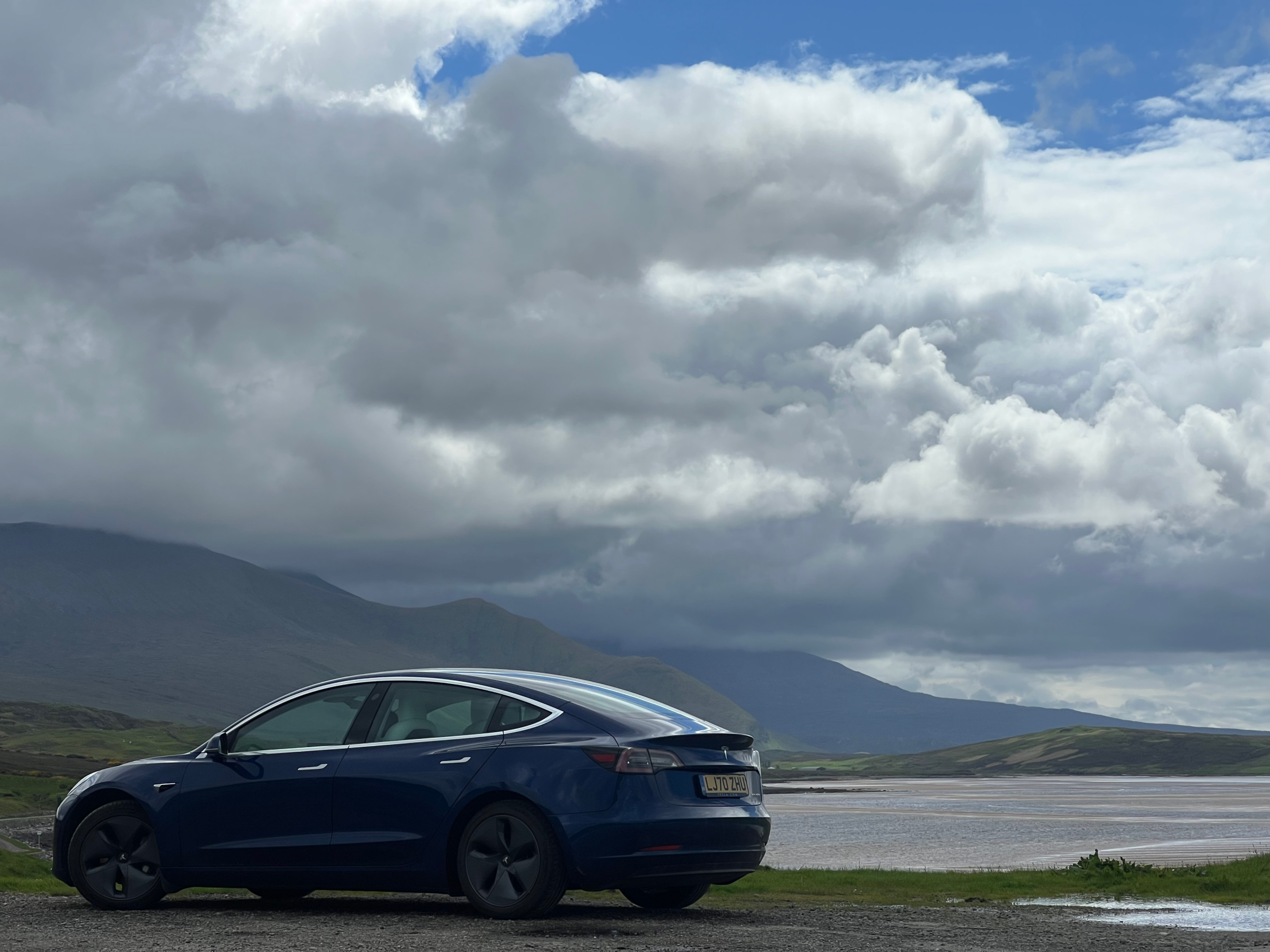
A few weeks ago, I drove the longest and most epic road trip one can do in the UK… driving up to northern Scotland to do a tour of the North Coast 500, and back again. And I did it in an electric car. All was fine.
What’s that faint echo I hear… range anxiety? Nah. None of it. A few points to make on that.
- Modern electric cars are incredibly capable, with many able to crank out 300 miles (or more) on a single charge. That’s over half of the NC500 in one go.
- I never want to drive more than 150 miles without a rest break. This allows time to charge.
- There are now over 100,000 public charge points in the UK, more than enough for my needs. And this number is growing all the time.
- If you’re going to drive the NC500, you need to plan for food and fuel, regardless of whether you have an EV or petrol vehicle. I love planning road trips, so had mapped out all the charging points on the NC500 in advance. (I didn’t literally map it – there are apps/websites which do this for you, but I knew where the chargers were.)
- The only part of the road trip with genuinely sparse charging was north of the Great Glen in northern Scotland. There was only one rapid charger (>50kW) north of here. Even in the few weeks since I’ve been back, Tesla have opened a new Supercharger in Brora.
- I was able to use Telsa’s fantastic Supercharger network for most of the journey. This got me all the way to Thurso, the most northerly town in Great Britain.

Tesla Supercharging Experience
This is a plug-in and charge experience and makes road tripping an electric vehicle easy and stress-free. As a Tesla owner, I simply drive up to a free stall, plug in and it starts charging within 5 seconds. No faffing around with apps or cards – the payment is taken automatically from my bank.
The chargers are reliable and (usually) charge at a good speed. I did have one issue when charging in Edinburgh, when I was only getting 32kW. This was solved by moving to a different stall. They are always conveniently located near local amenities like a restaurant, service station, shopping centre or local pub(s).
And they are far less expensive than third-party rapid chargers; pricing typically ranges from 45p/kWh during peak hours, to 21p/kWh off-peak. That’s massively lower than the flat 80-90p/kWh rate typically charged by third-party chargers. (Non-Tesla drivers can subscribe to these lower rates for £90 per year, or £8.99 per month.)
So, I’m a big fan of Tesla Superchargers. If you’re a Tesla driver, this is the only network you’ll ever need to use.

Charging in North-west Scotland
North-west Scotland has the worst public charging network in the country (and one of the worst in Europe). I can understand it – only a few thousand people live up here, in sparsely populated communities. But in the summer months, tourism swells – and you need a car if you’re going to get around. There’s no public transport, and points of interest are many miles apart.
I used the EZO charging network – who have requisitioned the old ChargePlace Scotland hardware, previously run by the local councils. These are a lifeline for EV drivers all along north-west Scotland, but fortunately they are located every 30 miles or so. Each charger generally has one 50kW option, and one 22kW option.
The worst charging experience I had was in Thurso, when I only managed to get 12kW. Fortunately, we had to go shopping, went for a walk and explored the town a little. So, the car was there for about three hours in total. We still got a decent charge, but I would have preferred it to be faster.
Otherwise I charged at between 35 and 50kW in Durness and Gairloch. Absolutely no issues in these places – because I was on holiday, I was glad for the break and ability to stretch my legs. And it’s not like these chargers are in some horrible industrial estate. They are in beautiful parts of Scotland with great views and beach walks easily accessible, encouraging even more exploration.
So, that was it; 1,732 miles and only three stops at third party chargers. Easy. Once I got to Fort William, it was back to the Tesla Supercharger network. As the UK’s public charging network continues to expand, the situation will only improve in the years to come; both Tesla and non-Tesla chargers will become faster, more reliable and more accessible.

The Driving Experience
Was fantastic. The smoothness and quietness of the electric motors, combined with the comfort of the cabin and ability to self-drive, make the Model 3 an excellent road trip car. It’s also fast as hell.
Aside from the slow third-party chargers in north-west Scotland, at Tesla Superchargers, we generally had all the electrons we needed after 20 minutes or less. That’s just enough time to go to the toilet, maybe order a coffee and have a look around the service station. Perfect.
I just love driving this car. It’s an experience unlike any internal-combustion car can offer. EVs typically have around 90% fewer moving parts than a petrol car, making them super reliable. I never once worried about the car not starting or breaking down, which I would do constantly with my old Corsa. On a long road trip, reliability is important.
The future of electric cars in the UK
The UK is at a key inflection point on the EV revolution. There are now over 2.1 million electric cars on the roads (this number increases every time I write a blog on the subject – and will no doubt be out of date by the time you read this). More than 1 in 20 cars on the roads are now electric.

The charging infrastructure is there to support the EVs currently on the road (and continues to scale rapidly). I think where we lag now is being able to maintain this fleet. There’s not enough technical expertise in garages on electric vehicles. This needs to (and will) change over the coming years, but I hope it comes fast enough. It’s going to put a lot of strain on garages as the shift in knowledge switches more on how to fix software problems and less on how to fix a broken fuel pump.
I look forward to doing more road trips over the coming years (and I have another planned in August – more on that in a future post!) I hope it’s clear that EVs works seamlessly, even in the most remote regions of Europe. I certainly have no intention of going back to a petrol car – and neither will you, I suspect, in a few years time!
If you liked this post, here are some others you may also enjoy:
- Are there enough EV chargers in the UK in 2026?
- Are cheap cars worth it?
- EVs are cleaner than you think
- Golden Rules for Career Success
- Why your £4 coffee actually cost £360
You can follow me on X, and find me on Pinterest, Instagram and Facebook.
Leave a Reply