
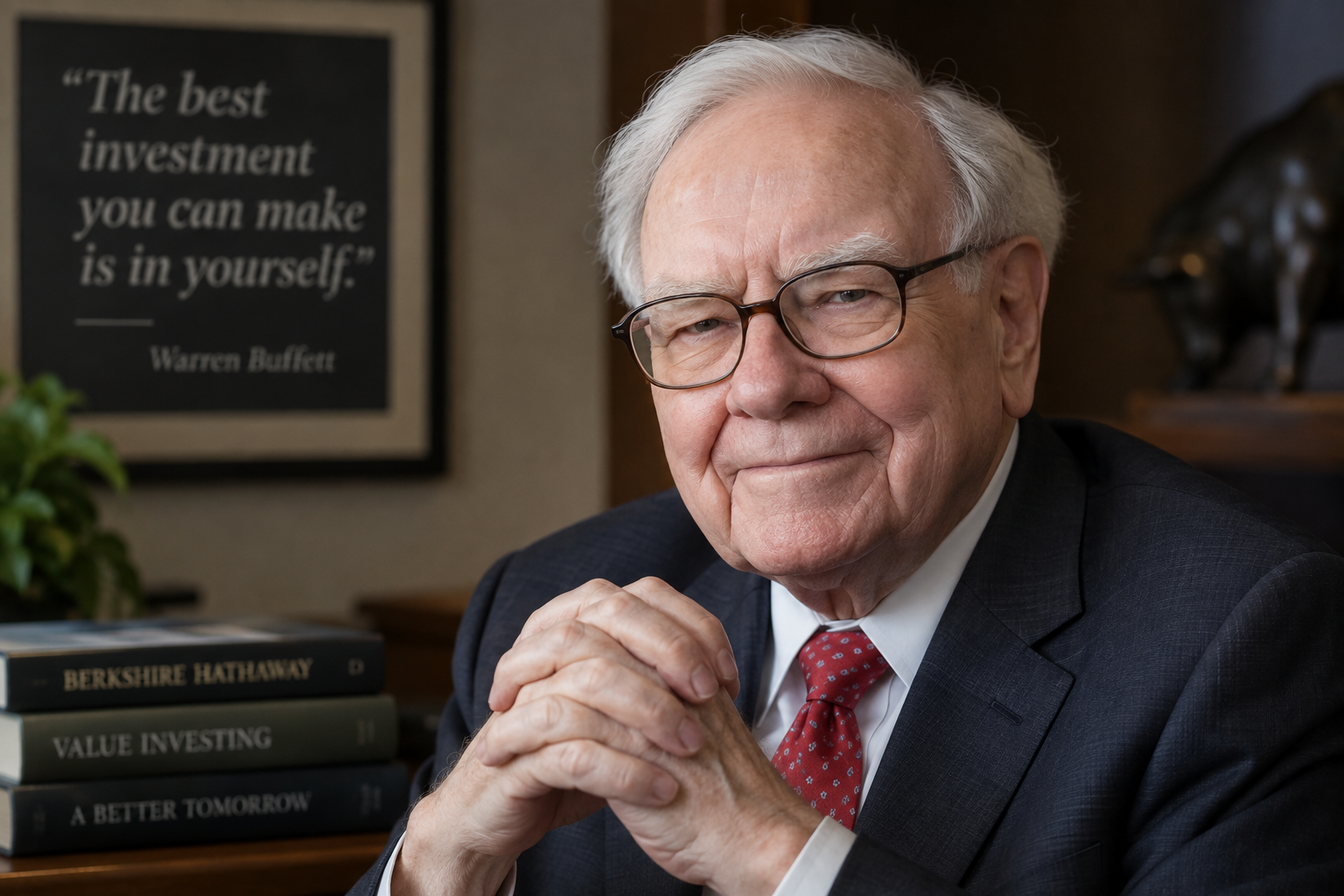
Warren Buffett is the world’s greatest investor. There, I said it. you may disagree, but few, if any investors throughout history can claim the same annual returns as Buffett. (19.9% per year on Berkshire Hathaways’s stock between 1965 and 2025, compared with 10.4% for the S&P 500, including dividends.) In any case, he’s a personal hero of mine.
Over the course of his life, he turned a small investment business into Berkshire Hathaway, one of the world’s largest companies, and accumulated a fortune measured in the hundreds of billions of dollars. And Buffett had some very simple principles that got him there.
He isn’t famous for making hundreds of trades every week, he doesn’t spend his days trying to predict where the stock market will be next Tuesday, nor is he interested in the latest investment fad. Instead, his approach has been to buy good businesses, at a fair price, hold them for a very long time, and allow the power of compounding to do the work.
While I wouldn’t recommend investing like Buffett (essentially stock picking), there are some valuable lessons for us to learn.
Start early. Then be patient.
Buffet bought his first shares at the age of 11, and filed his first tax return at 13! While these early investments weren’t necessarily successful, he started learning from an extremely young age. He has also spent the vast majority of his life allowing his investments to compound. The most important lesson in investing is to start early (and if you haven’t started early, the best time to start is right now), and let time do the heavy lifting.
It’s always tempting to look for ways to make our money grow faster. The next 2x, 5x, 10x investment, the next Nvidia or Tesla – but Buffett’s career shows the power of simply giving good investments time. You don’t need to be an investing genius or have an incredibly high IQ – so you can make more intelligent decisions than other investors (and believe me, however smart you think you are, there will always be a smarter and more experienced investor out there) – but you can beat the average return through your behaviour.
If you save regularly, invest sensibly and leave the money alone for decades, compounding will work wonders for you. Time is the investor’s secret weapon.
Think like an owner
Buying shares is not something superficial – it’s not just numbers on a screen that you expect to go up over time. Buying shares means buying a tiny slice of real businesses – with real people working really hard to make really good products. You own something real here.
When you see that an index fund has fallen 15%, it’s very easy to think of that as a loss on a screen (and I think we all feel like this when we start investing). But underneath that number are hundreds or thousands of actual businesses, employing people, selling products and services, and generating profits.
Consider the underlying business. If you owned the whole company, would you be worried simply because someone offered you 15% less for it today?
This psychology encourages a much longer-term perspective. The stock market becomes a mechanism for owning productive assets rather than a casino where we constantly try to guess which way prices will move next.
Stay inside your circle of competence
Buffett has spoken extensively about his circle of competence. The idea is that you don’t have to understand everything.
There are tens of thousands of publicly traded companies around the world, operating in industries ranging from biotechnology to AI, to mining, banking and insurance. Nobody can understand all of them. Read that last line again.
Buffett has always invested in businesses whose economics he understands. For us ordinary investors, the lesson is to accept that we can’t understand the market, or even a single sector (most likely), better than the hundreds of thousands of traders and analysts who do this professionally. Being humble by broadening your investments will pay dividends.
The price you pay matters
A fantastic company can be a poor investment if you pay an absurd price for it. Conversely, something that looks cheap isn’t necessarily good value if the underlying business is deteriorating. This is another reason Buffett focusses on the actual businesses he invests in rather than the stock tickers.
This reinforces the importance of not chasing whatever stock has recently increased in value the most.
Don’t just do something! Stand there.
The most underrated investment skill is doing nothing. This might sound blindingly simple – but when the rest of the market is scrambling around reacting to the latest disastrous news headline or investment trend – trust me, it’s not.
Buffett was remarkably patient when the right opportunity didn’t present itself. His approach was to hold cash until attractive investments become available, rather than feel compelled to invest simply for the sake of it. The same principle applies to you and I.
If you already have a sensible investment strategy that you are comfortable with, don’t tinker with it.
Your temperament matters
Investing success is more about your behaviour and temperament than your intelligence. You can be incredibly clever and still make terrible investment decisions if you panic when markets fall or become greedy when everything goes up. You need to be comfortable with watching your portfolio drop by 30% or more – and still be confident that your strategy will succeed in the long run.
You must recognise that volatility is part of the process of owning stocks. It’s a roller coaster ride, and if you can’t accept that, you don’t deserve to own stocks. This is why I like the simplicity of global index investing. You aren’t betting on one company being successful. You’re owning a diversified collection of businesses from around the world, accepting that markets will sometimes behave badly.
Avoid the things that can destroy you
Buffett has consistently emphasised the importance of avoiding catastrophic mistakes. You should never maximise every possible return if doing so exposes you to the possibility of losing everything.
Leverage, debt, speculative investments, stock picking, excessive fees and complicated financial products can all create risks that aren’t needed to build wealth.
Get rich slowly by spending less than you earn, avoiding debt and investing the difference. Don’t gamble your future on one big bet.
Remember what money is for
Buffet asks: “What’s the point of accumulating enormous amounts of money if you don’t have time to enjoy your life?” (Or if you won’t spend it.) Buffett may have been a great investor, but he also thinks intentionally about money.
Money is useful because of what it allows us to do. It gives us options. It provides security. It can give us freedom to change jobs, take time off, travel, spend more time with our families or pursue something that matters to us. Accumulating money is not the objective in itself.
Warren Buffett may be one of the richest people in the world, but he has also given away $72 billion (yes, you read that right). Now that he has accumulated huge wealth, his goal is to give away 99% of it. He is reminding us that money is ultimately a tool.
We shouldn’t invest like him
Buffett has spent a lifetime analysing individual businesses. Most of us don’t have the time, knowledge or patience to do this. To be much better than the average investor, it really is a law of diminishing returns. You can reduce costs, diversify and stay the course to see slightly better returns than average – and this is the best most of us can hope for. But to see much better returns, you must dedicate your whole life to investing – most likely making a career out of it – and you have to be extremely gifted. Buffett has that rare combination, but the rest of us (well, 99.99%), do not.
Instead, Buffett has repeatedly recommended low-cost index funds for the ordinary investor. (In fact, Buffet himself has instructed the trust fund for his wife to be invested 90% in a low-cost S&P500 index fund, and 10% in short-term government bonds.)
Regardless, his guiding principles are still applicable for the ordinary investor. Invest for the long term. Keep costs low. Don’t invest in things you don’t understand. Avoid unnecessary risk. Be patient. Don’t panic when markets fall. Let compounding work. And perhaps most importantly, don’t confuse wealth with spending.
Buffet’s greatest lesson is very simple:
Don’t get rich quickly.
Make sensible decisions, avoid catastrophic mistakes, and give those decisions enough time to compound.
I hope you enjoyed this article. Here are some others you may like:
- The $8 Million Janitor
- The Quiet Millionaire: the Sylvia Bloom Investing Story
- Rich Dad Poor Dad
- Why Cryptocurrencies are not an Investment
- Why £200k is investing’s magic number
You can follow me on X, and find me on Pinterest, Instagram and Facebook.
Leave a Reply