
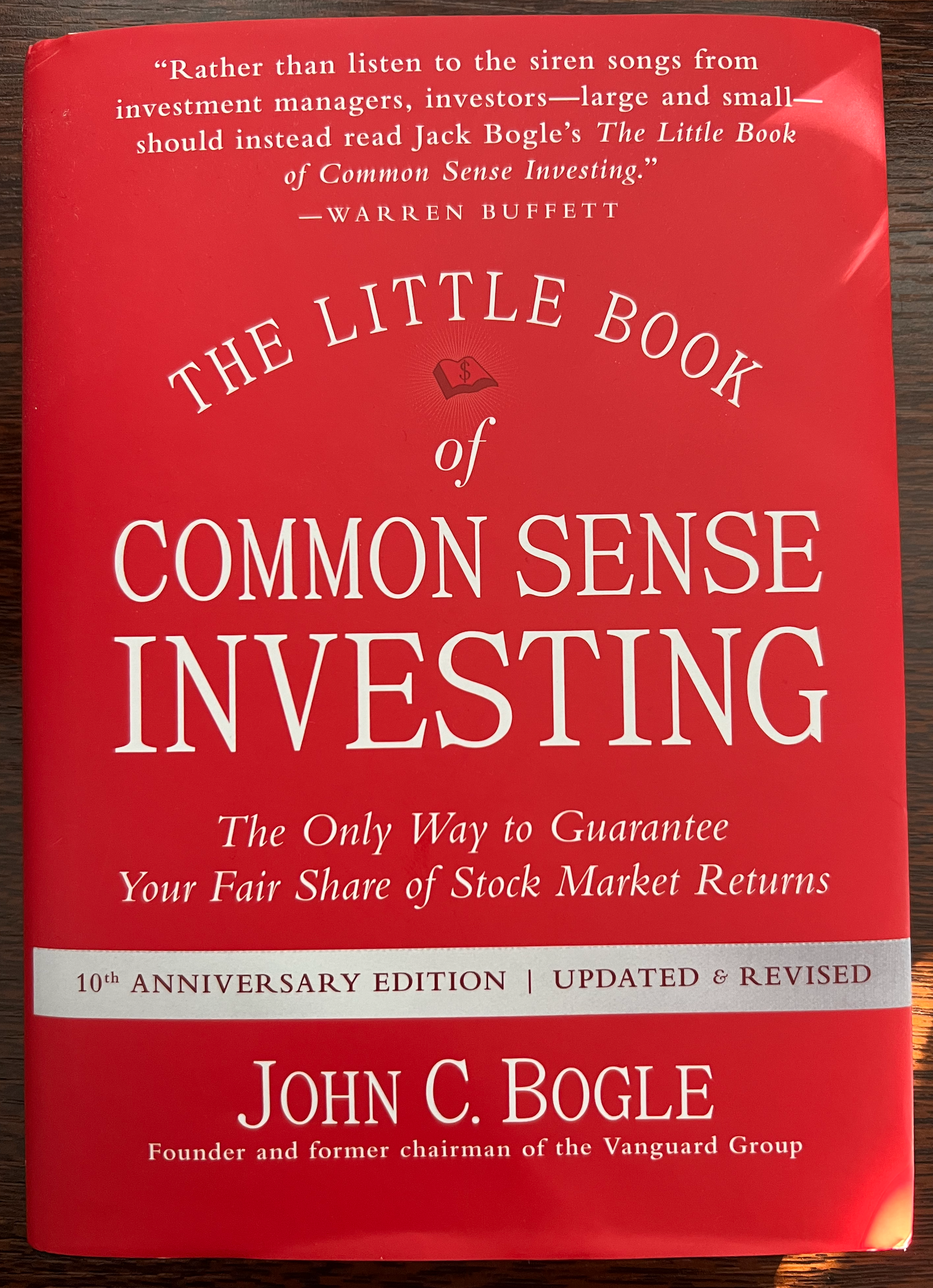
Unlike many personal finance books that rely heavily on stories, motivation, or flashy promises of wealth, John Bogle takes a far more evidence-based approach in his book, The Little Book of Common Sense Investing. His central argument is simple:
Most investors should stop trying to beat the market and instead buy the entire market through low-cost index funds.
At first glance, this may not sound revolutionary. It even sounds boring. But the power of the book comes from how thoroughly Bogle dismantles the case for active investing using decades of real-world data.
This isn’t necessarily the easiest investing book to read. It’s more analytical and statistics-heavy than something like The Simple Path to Wealth by JL Collins. But if you can look past the denser sections, the logic becomes incredibly compelling. Bogle simply presents the evidence to you – and it’s hard to argue with.
Own the market
The fundamental principle of index investing is beautifully simple: instead of trying to pick the winning stocks, you buy all of them.
An index fund owns hundreds or thousands of companies, giving you broad diversification and allowing you to capture the return of capitalism itself. Rather than betting on which company, sector, or fund manager will outperform next year, you simply accept the market return. This sounds modest, but has historically been very effective.
One of Bogle’s most important observations is that before costs, investors as a group collectively earn the market return. After costs, however, investors must underperform the market on average, because fees, taxes, trading costs, and fund expenses all reduce returns. High fees make winning much harder.
Costs matter!
A major theme throughout the book is the destructive effect of fees and costs over long periods of time. A 1% annual fee may not sound like much initially, but over decades it quietly compounds against you. Bogle repeatedly demonstrates how even seemingly small costs can consume enormous portions of an investor’s lifetime returns.
This is one of the reasons why low-cost index funds are so powerful; by minimising costs, you keep more of the market’s returns for yourself. This aligns strongly with the broader philosophy of intentional living promoted by this website. Successful investing is not about complexity or brilliance, but about removing unnecessary friction and staying disciplined for a long time.
Most fund managers fail to outperform
One of the most compelling parts of the book is Bogle’s presentation of long-term data on actively managed funds. While some active managers outperform the market over short periods (1-5 years), very few sustain this over multiple decades. Any how do you identify these future outperforms in advance? It’s just not possible.
This is an uncomfortable truth because the financial industry is built around the idea that experts can consistently beat the market. Bogle challenges this – he argues that many investors are paying high fees for the illusion of control, sophistication, or market-beating skill.
However, over long periods, low-cost index funds routinely outperform the majority of actively managed funds after fees and taxes are considered. This is one of the reasons I personally find indexing so appealing. It removes the pressure to constantly predict, optimise, or outsmart millions of other market participants.
Instead, you focus on the things you can control:
- Your savings rate.
- Your investment costs.
- Your asset allocation.
- Your consistency.
- Your behaviour during market volatility.
This boring approach often leads to better outcomes than constantly chasing the next big opportunity (and it also gives you more time to live life).

Time and compounding do the heavy lifting
Another message woven throughout the book is the importance of patience. Successful investing is rarely exciting in the moment. The real magic happens slowly, quietly and often invisibly during the early years. This is something I’ve written about many times on Slow Down and Save. You do not need to find the next hot stock tip to build wealth. Bogle discourages this. Instead, buying diversified index funds over decades is enough.
This sounds almost disappointingly simple, but such simplicity is rare. Oftentimes, the best explanation for a complex topic is the simplest.
Bogle’s philosophy accepts that markets are unpredictable in the short term, while remaining optimistic about long-term human progress and capitalism as a whole. And I entirely agree with this; index fund investing is really a bet on humanity continuing to innovate, build and grow over time.
My thoughts on the book
This book is not a light or entertaining read like The Simple Path to Wealth. There were sections where the statistics and repetition became fairly dense. But at the same time, that relentless data-driven approach is exactly what makes the argument so convincing. By the end of the book, it’s very difficult to justify high-cost investing strategies unless you genuinely believe you possess some form of magic edge over the market.
For most of us, we probably don’t – and that’s okay – there’s actually something deeply freeing about accepting this. The irony is that, in accepting that you’re just an average investor, you’ll end up with well-above average returns over time.
So, you can stop chasing predictions, stop worrying about market noise and instead focus on building your own life. Focus on your own health, family/ friends, and work (in that order), while your investments quietly compound in the background. That philosophy resonates strongly with me.
Conclusion
The central message of The Little Book of Common Sense Investing is ultimately one of humility. The market is incredibly difficult to beat consistently. Costs matter enormously, and simplicity often wins. Rather than trying to beat capitalism at it’s own game, Bogle suggests something much better:
Own capitalism itself.
This is perhaps the most powerful idea in all of personal finance.
I hope you found this article interesting. Here are some others you may also enjoy:
- 7 Best Personal Finance Books to Read in 2026
- The $8 Million Janitor
- Vanguard’s Four Key Principles for Successful Investing
- Don’t Dance with the Stock Market
You can follow me on X, and find me on Pinterest, Instagram and Facebook.
Leave a Reply