
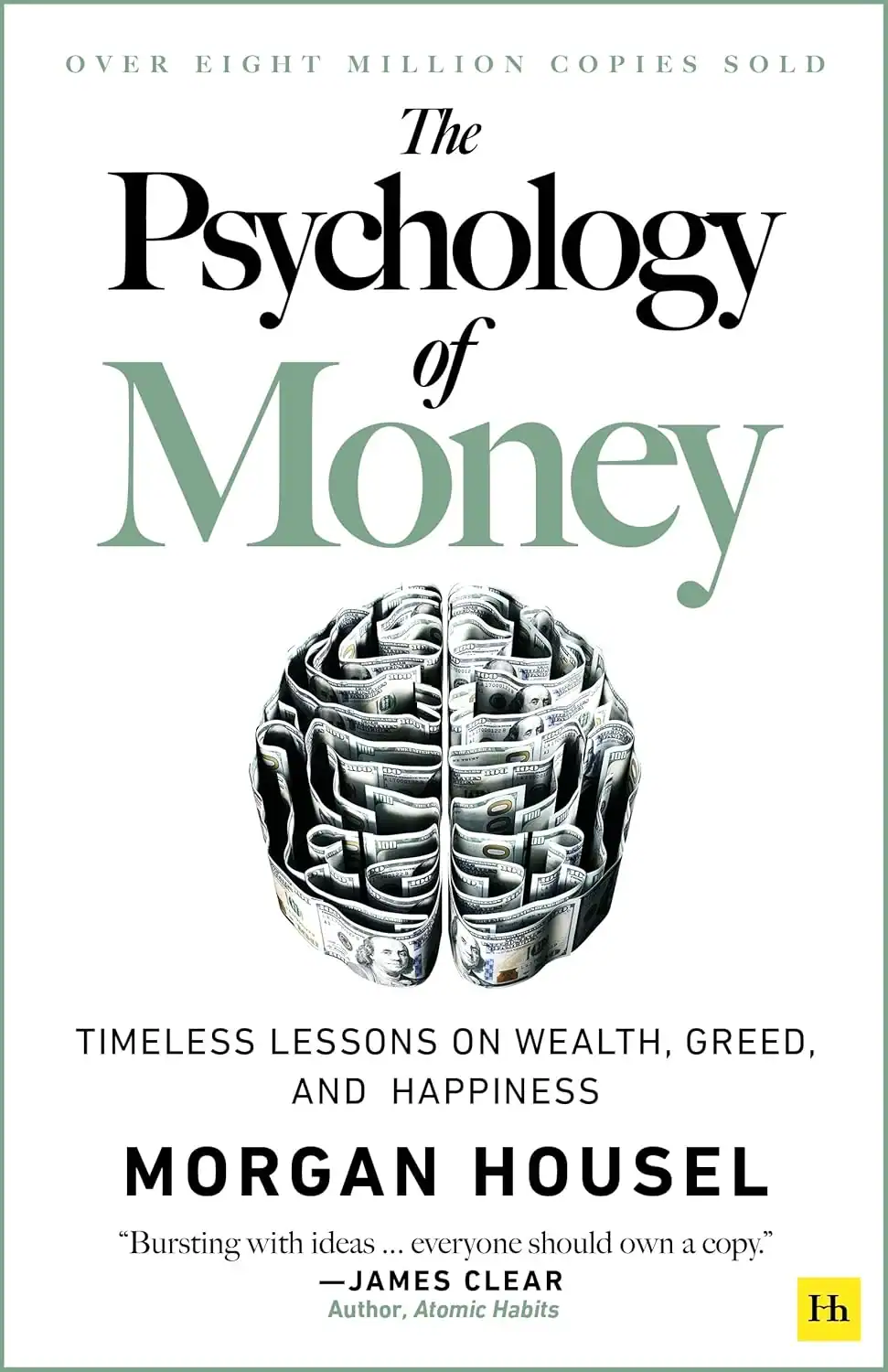
The Psychology of Money by Morgan Housel explores why we behave the way we do with money, rather than focussing primarily on what we should do with it. Understanding why enables you to tackle the issue of what to do with money at the root cause – understanding why we make such emotionally-driven financial decisions gives you the tools to avoid them altogether – or at least try to maintain some control over your emotions when you need to make major financial decisions.
I recently read The Psychology of Money, and these are some of the lessons that stuck with me:
1. Nobody is crazy
One of Housel’s central arguments is that our relationship with money is shaped by our personal experiences. Someone who grew up during a recession might have a very different attitude towards debt and saving than someone who grew up during a period of booming house prices and rising stock markets.
Neither person is necessarily wrong – they have simply learned different lessons from their experiences.
This is important when we look at other people’s financial decisions. What seems completely obvious to us might not seem obvious to somebody with a different financial history. There is no single “correct” way to think about money.
2. Being reasonable is more important than being rational
Traditional financial theory assumes people make rational decisions. For example, it is well known that, for the vast majority of investors, holding on to low-cost, diversified index funds is the best way to outperform most investors over time. But can you hold on during a market crash? Humans aren’t computers. We are complex – we have emotions, we worry, we become greedy, we panic when our investments fall by 30%.
Rather than trying to construct the mathematically perfect financial plan, Housel argues that it is much more important to create a plan that you can actually stick to. An investment strategy that theoretically produces a slightly higher return is useless if you abandon it during the next market crash.
Consistently good financial behaviour beats financial perfection.
3. Compounding needs time
Compound interest is a superpower, and Housel spends considerable time discussing it.
To generate enormous wealth, you need to start investing young, and continue doing so for many decades. This is important to understand, because we often focus on finding investments that will generate spectacular returns, but neglect a much more simple variable we can control:
Time.
The earlier we start investing, the longer our money has to compound. Getting rich is actually a very boring process in the majority of cases – you just need to give your money enough time to grow.
4. Wealth is what you don’t see
This is a concept which certainly resonates (harmonically) with me.
We generally associate wealth with visible things: expensive cars, large houses, designer clothes and holidays. But these are examples of spending, not necessarily wealth. For example, 80-90% of new cars in the UK are bought using finance. True wealth is the money you haven’t spent. It’s the investment portfolio sitting quietly in the background, the pension you are building, the emergency fund that gives you security.
This is one of the reasons intentional living and personal finance fit together so well. Having more money and spending more money aren’t the same thing.
5. Know when you have enough
Perhaps the most important lesson in the book is the idea of “enough“.
There is always somebody richer. If your goal is to accumulate as much money as possible there is no obvious finish line. You can always earn more, invest more, buy a bigger house, drive a more expensive car.
But at some point, the pursuit of more can become counterproductive.
Housel highlights the danger of risking what you already have in pursuit of something you don’t really need. Knowing when you have enough is a form of financial freedom in itself.
6. Just save
We often think of saving as something we do for a specific purpose. But Housel makes the case for saving simply because having money gives you options. You don’t necessarily need to know what those options will be. Perhaps you will change career, start a business, take six months off work, help a family member, or retire earlier than expected.
Financial flexibility is valuable precisely because we cannot predict the future. This is why I think saving is about much more than just accumulating money.
7. The most important financial decision is behavioural
This is ultimately what The Psychology of Money is about. Personal finance is usually presented as a numbers game – but the numbers are only part of the story. Yes, your savings rate matters, your investment returns matter, inflation matters. But so do patience, discipline, expectations and your ability to stay calm when things go wrong (which they inevitably will).
The best financial plan is the one that allows you to sleep well at night. The point of becoming financially secure is to create a life with more freedom, flexibility and choice. we shouldn’t be trying to optimise every last part of our finances to get there. Make financial decisions that your emotions can deal with, stay the course and let time do the rest.
Final thoughts
The mathematics of personal finance are startlingly simple: spend less than you earn, stay out of debt and invest the difference. The difficult bit is sticking with that plan for decades.
This is why I enjoyed The Psychology of Money – it’s about how we think about money. Housel demonstrates that successful investing is less about intelligence and more about behaviour. Be patient, know what is enough, save more than you need to, expect uncertainty, and don’t take risks that could destroy what you’ve already built.
Finally, remember that money is a tool, not the goal in itself. The objective isn’t to be the richest person in the graveyard. It’s to use your money to build a life you actually want to live.
I hope you enjoyed this post. Here are some others you may like:
- I drove a Tesla to Northern Scotland and back
- Can a Cheap Index Fund Really Beat the World’s Best Investors?
- How to build wealth in the UK on an average salary
- Why Discipline and Consistency are the Ultimate Life Skills
- How to Make the Most of Your Workplace Pension
You can follow me on X, and find me on Pinterest, Instagram and Facebook.
Leave a Reply